Malaysia is at the forefront of a sustainable revolution in public infrastructure. As the nation transitions from traditional grid-tied lighting to clean energy, solar street light solutions have become a strategic priority for government agencies and private developers alike. Driven by the "Green Technology Master Plan 2017-2030" and the pursuit of "Low Carbon Cities" status in regions like the Klang Valley, Penang, and Johor, the demand for resilient, high-performance lighting has never been higher. This guide provides an expert-level analysis of solar street lighting specifically engineered for Malaysia's tropical rainforest climate—characterized by extreme humidity, heavy monsoon rains, and the world's highest lightning frequencies. We explore the technical specifications of high-efficiency monocrystalline panels, advanced LiFePO4 battery storage, and JKR-standard compliance. Furthermore, we demonstrate why RCTraffic is the preferred partner for large-scale Malaysian projects, offering superior durability and smart management capabilities.
For Malaysian municipal councils like DBKL (Kuala Lumpur) and MBPJ (Petaling Jaya), traditional grid lighting presents two major challenges: escalating electricity costs and high maintenance due to frequent power surges during thunderstorms. Malaysia's high lightning density causes significant damage to underground cabling and grid-tied luminaires, leading to dark streets and costly repairs. Moreover, the push for "Green Township" status requires developers to integrate renewable energy into their infrastructure from the design phase.
The adoption of solar lighting is strategically vital across Malaysia's key economic zones: - Klang Valley (KL & Selangor): Supporting urban density and reducing the carbon footprint of the nation's most developed region. - Penang & Johor (Iskandar Malaysia): Providing sustainable lighting for high-tech industrial parks and new residential townships. - East Malaysia (Sabah & Sarawak): Offering a cost-effective alternative to grid extension for remote "Kampung" roads and coastal communities where terrain makes cabling prohibitively expensive.
A solar street light in Malaysia must be more than just "solar-powered"; it must be "tropicalized" to survive the environment.
With Malaysia's frequent cloud cover and haze, every photon counts. Monocrystalline panels, with conversion efficiencies exceeding 21%, are essential. They perform significantly better than polycrystalline panels in low-light and overcast conditions, ensuring that the battery continues to charge even during the rainy season.
Traditional lead-acid batteries fail within months in Malaysia's 30°C+ average temperatures. Lithium Iron Phosphate (LiFePO4) is the gold standard for Malaysian projects: - Thermal Stability: They can withstand the high internal temperatures of solar fixtures without the risk of swelling or fire. - Long Cycle Life: Offering 2,000+ cycles, they provide a 5-8 year lifespan, drastically reducing maintenance cycles compared to traditional batteries. - JKR Compliance: Modern JKR specifications increasingly favor high-performance lithium energy storage systems for their reliability.
The controller is the most critical component during the monsoon season. RCTraffic’s patented PRO-DOUBLE MPPT (Maximum Power Point Tracking) technology optimizes charging by up to 30%. It utilizes dual-channel optimization to harvest energy even in deep shade or heavy rain, ensuring 365-day continuous lighting.
| Feature | All-in-One (Integrated) | Split-Type |
|---|---|---|
| Components | Compact; Panel, Battery, LED in one unit | Separate; Panel can be much larger |
| Installation | Extremely fast; ideal for urban areas | Requires more labor; ideal for highways |
| Vandalism Resistance | High (integrated design) | Moderate (external components) |
| Best For | Parks, G&G residential, Kampung roads | Federal highways, JKR roads, large intersections |
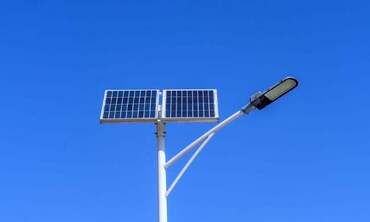
For the Public Works Department (JKR), solar street lights must meet strict safety and performance standards. Split-type systems are often used for federal highways to provide the high lumen output (lux levels) required for vehicle safety. These systems are immune to the localized power outages that often plague grid-tied highway lights during storms.
In high-end Gated & Guarded developments by developers like Sime Darby or Gamuda, solar lighting enhances the "Green" appeal while lowering the service charges for residents. In industrial zones like Shah Alam, Nilai, or Kulim, solar provides reliable security lighting for perimeters and logistics hubs without the need for disruptive trenching.
Malaysia has one of the highest lightning strike rates in the world. - Surge Protection Devices (SPD): Every RCTraffic unit is equipped with high-level surge protection to prevent damage from induced currents during strikes. - Earthing/Grounding: For tall poles, a proper earthing system with a resistance of less than 10 ohms is recommended to safely dissipate lightning energy into the ground.
Tropical downpours in Malaysia can be horizontal and intense. - IP67 Sealing: Our fixtures use high-grade silicone gaskets and waterproof connectors to ensure that even during a "Banjir" (flood) or heavy storm, no moisture enters the sensitive electronics. - Anti-Condensation: Ventilated designs prevent moisture buildup inside the lens, which can occur in high-humidity environments.
In forested areas or high-density urban canyons like the Klang Valley, shading is a major concern. - Smart Dimming: Using PIR or microwave sensors to reduce brightness when no motion is detected can extend battery autonomy to over 7 days, ensuring the light stays on even if the panel is partially shaded during the day.
RCTraffic’s products are designed with the "Southeast Asian Tropical Standard" in mind.
Our housings are made from ADC12 Die-cast Aluminum, which acts as a massive heat sink. This prevents the "cooking" of the LED chips and battery, a common cause of failure in cheaper plastic or thin-metal alternatives in the Malaysian heat.
Imagine managing 1,000 lights across a township from a single dashboard. RCTraffic’s IoT modules allow municipal councils to: - Monitor battery health and solar charging in real-time. - Adjust dimming schedules remotely for festive seasons (e.g., Hari Raya). - Receive instant alerts for any failed units, eliminating the need for manual "patrol" inspections.
While the initial cost of solar is higher, the Return on Investment (ROI) for a Malaysian project is typically 24-36 months. - Zero TNB Bills: A 60W LED solar light saves approximately RM 400-500 per year in electricity costs. - Zero Trenching: For new roads, the savings on copper cables, conduits, and manholes often exceed the cost of the solar lights themselves. - Carbon Credits: Large-scale solar deployments can contribute to a corporation's ESG (Environmental, Social, and Governance) goals, potentially qualifying for tax incentives under MIDA’s Green Technology incentives.
With over 12 years of experience and a presence in over 60 countries, RCTraffic understands the nuances of the Malaysian market. We have successfully deployed thousands of units in similar climates, ensuring our products are battle-tested for the tropics.
We design our products to align with JKR L-S20 and other local municipal standards. From the CRI (Color Rendering Index) to the pole's wind-load resistance, every detail is engineered to meet the expectations of Malaysian engineers and procurement officers.
The shift to solar street lighting is an essential step toward Malaysia's vision of a sustainable, high-tech future. By eliminating electricity costs, reducing maintenance, and providing resilient illumination during storms, solar solutions offer an unparalleled value proposition for both the public and private sectors.
Explore RCTraffic’s high-performance solar street light solutions here: https://www.rctraffic.com.
Whether you are a municipal council in the Klang Valley or a developer in East Malaysia, RCTraffic is ready to illuminate your project with world-class technology. Contact us today for a professional project consultation, bulk inquiry, or to discuss local distribution partnerships.
Q1: How do RCTraffic solar lights perform during the "Musim Tengkujuh" (Monsoon Season)? A1: Our lights are designed with a 5-7 day autonomy. This means that even if there is zero direct sunlight for a week, the intelligent PRO-DOUBLE MPPT controller and high-capacity LiFePO4 battery will keep the lights operational through smart power management and dimming.
Q2: Is it safe to install solar street lights in high-lightning areas like Subang or Petaling Jaya? A2: Yes. RCTraffic units are equipped with internal surge protection. For projects in high-risk areas, we recommend a complete lightning protection system (LPS) for the pole, including a dedicated earthing rod, to ensure maximum safety for the equipment.
Q3: How does the high humidity in Malaysia affect the lifespan of the battery? A3: Humidity can lead to corrosion in standard batteries. We use hermetically sealed LiFePO4 battery packs with IP67-rated enclosures. This keeps moisture out, ensuring the battery achieves its full 5-8 year lifespan regardless of the humidity levels in coastal or rainforest areas.
Q4: Do these lights meet JKR (Public Works Department) standards for road lighting? A4: Yes. Our technical specifications for lumen output, light distribution (Type II/III optics), and component durability are designed to meet or exceed the requirements set by JKR and local municipal councils. We can provide the necessary test reports for your tender submissions.
Q5: What is the maintenance schedule for a solar street light in a Gated & Guarded community? A5: Maintenance is extremely low. We recommend a visual inspection once a year to check for any physical damage and a quick cleaning of the solar panel if there is significant dust or bird dropping accumulation. Our IoT system can also provide automated health reports, further reducing the need for manual checks.
Q6: Can we use these lights for coastal jetties in East Malaysia? A6: Absolutely. We offer specialized "Marine Grade" versions of our fixtures with anti-corrosion coatings (C4/C5 standard) and high-grade aluminum housings that are specifically designed to withstand the harsh salt-air environment of coastal Sabah and Sarawak.
The history of public lighting in Malaysia has mirrored the country's rapid development. In the early years of independence, high-pressure sodium (HPS) lamps were the standard, lighting up the growing urban centers of Kuala Lumpur and George Town. While effective for visibility, these lights were energy-intensive and required frequent maintenance.
As Malaysia entered the 21st century, the shift toward LED technology began, significantly reducing energy consumption. However, the reliance on the national grid (TNB) remained a bottleneck, especially in expanding rural areas and during the intense tropical storms that frequently cause localized power outages.
Today, the evolution has reached its next stage: Sustainable Solar Solutions. This transition is not merely about changing the power source; it's about building a resilient, decentralized infrastructure that aligns with Malaysia's commitment to the Paris Agreement and its goal of becoming a carbon-neutral nation by 2050.
The Public Works Department (JKR) has played a pivotal role in this evolution. By setting high standards for road lighting (such as the L-S20 specification), JKR ensures that any technology deployed on Malaysian roads—whether solar or grid-tied—meets the necessary safety and durability requirements. RCTraffic’s alignment with these standards ensures that our solutions are not just innovative, but also compliant with the rigorous demands of Malaysian engineering.
Malaysia's climate is one of the most challenging in the world for outdoor electronics. To succeed here, a solar street light must be engineered from the ground up to handle three main factors: Heat, Humidity, and Rain.
Heat is the enemy of electronics, especially batteries and LEDs. In Malaysia, where ambient temperatures regularly exceed 30°C, internal temperatures within a sealed solar fixture can reach 60°C or higher.
Malaysia's average humidity of 80% can cause rapid corrosion of metal parts and electrical connections.
The Malaysian monsoon can bring weeks of overcast skies. A standard solar light might work in the summer but fail in December.
For property developers and municipal councils, the decision to go solar is often driven by the bottom line.
The cost of connecting a new street lighting system to the TNB grid can be significant. This includes:
Traditional grid lighting requires a fleet of maintenance vehicles to replace bulbs and repair cable faults. Solar street lights, with their 50,000+ hour LED lifespan and 5-8 year battery life, require significantly fewer site visits.
Under MIDA (Malaysian Investment Development Authority), companies investing in green technology can qualify for the Green Investment Tax Allowance (GITA) or the Green Income Tax Exemption (GITE). These incentives can significantly improve the project's financial feasibility and contribute to a company's ESG reporting, which is increasingly important for attracting international investment.
A premium residential development in the Klang Valley installed 200 RCTraffic all-in-one solar street lights. The developer saved over RM 150,000 in cabling costs and provided the residents with a "zero-electricity" lighting system that continues to work even during the frequent power outages in the area.
A large logistics park near the Port of Tanjung Pelepas used solar lighting for its perimeter and parking areas. The lights were chosen for their ability to be installed quickly without disrupting the heavy truck traffic. The project has since become a model for "Green Logistics" in the region.
JKR Sarawak installed solar street lights on a series of remote bridges along a federal road. The project has significantly improved nighttime safety for rural commuters and avoided the multi-million ringgit cost of extending the power grid through the dense rainforest.
The transition to solar street lighting is more than just a technological upgrade; it is a commitment to Malaysia's future. By embracing clean energy, smart technology, and resilient infrastructure, Malaysia can build cities and communities that are not only efficient but also sustainable for generations to come.
Explore RCTraffic’s high-performance solar street light solutions here: https://www.rctraffic.com.
RCTraffic is proud to be a partner in Malaysia's journey toward a brighter and greener future. Contact us today for a comprehensive project evaluation and discover how our solar lighting solutions can transform your next project.