
Thailand is rapidly transforming its cities with “Smart City” initiatives that emphasize sustainability and high-tech urban infrastructure. In this vision, solar-powered systems feature prominently: smart city projects are integrating solar-powered infrastructure and smart grids to reduce emissions and lower energy costs. In such a context, road safety devices like solar road studs fit perfectly – they turn roads into self-illuminating, energy-efficient pathways. By night, these solar LED “cat’s eyes” can glow without any wiring, powered entirely by daylight. Moreover, Thailand’s intense tropical sun poses a challenge: ordinary plastic stud markers often heat up to extreme temperatures and can warp or fade under UV exposure. High-strength glass-encapsulated solar studs are emerging as a solution. These 360° reflective solar studs offer both durability and all-round visibility, making them ideal for Thailand’s hot climate and busy tourist roads.
In the sections below, we explore why traditional plastic studs fail in Thailand’s sun, how 360-degree glass road studs like the RC-SRS-B2 overcome these issues, and why they make sense for highways, resorts, and city zones. We compare material durability and visibility (see tables below), and detail practical scenarios—from Bangkok’s bike lanes to Phuket’s scenic curves. Finally, we address technical FAQs like installation on asphalt vs. concrete, and considerations for bulk shipping. This guide aims to provide Thai infrastructure planners and B2B resellers with a deep, actionable understanding of solar glass road studs – their advantages, applications, and long-term value.
.png)
Thailand’s summer temperatures often exceed 40°C in the air, with road surfaces far hotter. In direct sunlight, asphalt can reach well over 60°C, conditions under which cheap plastics begin to deform. In fact, industry tests show “hot climates damage many road products. Plastic studs soften under strong sun. Shape changes reduce visibility and strength”. Rubberized or polycarbonate road markers may lose their shape, become brittle, or even melt, leading to frequent failures. By contrast, road studs made with tempered glass (and aluminum bodies) stay solid in heat. Wistron Technology notes that aluminum studs “keep their form in high temperatures. They do not warp or melt,” making them ideal for tropical roads. Likewise, tempered glass can handle repeated heating and cooling without cracking. This means a glass-housed solar stud like the RC-SRS-B2 will maintain its shape and clarity even when embedded in Thailand’s sun-baked pavements.
Moreover, prolonged UV exposure can degrade materials. Plastic reflectors often fade, yellow, and crack after just a few years of sun. In contrast, tempered glass is inherently UV-stable. Its refractive clarity and color remain intact, so the stud stays bright and highly reflective. In short, when ground temperatures hit 50–60°C under the Thai sun, glass-encased studs handle the heat; plastic ones risk softening and failure.
Thailand’s roads see heavy night-time traffic from tourists, especially in beach resorts and mountainous areas (Phuket, Pattaya, Chiang Mai, etc.). On winding or busy roads, high-visibility road markers are critical. Standard studs often shine light in only one direction, leaving “blind spots” when a vehicle’s approach angle is off-axis. In challenging conditions like curves or narrow mountain roads, drivers need advance notice of lane edges from all directions. This is where 360° solar road studs excel: their dome shape reflects vehicle headlights back from any angle, giving drivers clear guidance on curves well before they arrive. One Taiwanese manufacturer explains that flat, square reflectors fail if the headlight hits them at a steep angle, whereas 360° glass studs “reflect the lights from any direction helping the drivers to see the curves in advance”. In practice, this means motorists approaching a roundabout or a tight bend will see glass cat’s eyes glowing under their wheels from all sides, improving reaction time and safety. For tourist-centric highways and scenic roads, this full-range visibility is a major benefit.
Thai resellers know the pitfalls of conventional road studs. Many common solar or reflective studs use polycarbonate or other plastics for the housing. Over time under Thailand’s sun, these plastics tend to yellow, crack, or warp. Wistron’s analysis notes that UV radiation “weakens many materials. Plastic fades and cracks after long sun exposure”. Repeated cycles of wet and dry weather also stress plastics, making them brittle. After heavy rains, water infiltration through minor cracks can occur if sealing is poor. In fact, in wet conditions drivers rely more on road markers, but any leakage can short out LEDs or corrode wiring. In short, low-quality plastic studs often need replacement within a few years under Southeast Asian weather.
Resellers also report that cheaper plastic studs have limited load ratings. Over time, heavy trucks or buses can damage them; plastic bodies may crack under 10–20 tons of pressure, causing sharp edges. By comparison, glass studs typically boast 20–40 ton ratings. Inadequate compressive strength means brittle studs on a busy Thai highway can break or become dislodged under the weight of tour buses. Such failures lead to customer complaints and warranty claims.
Another pain point is the directional limitation of many road studs. Traditional studs often reflect light only in one or two fixed directions. On straight roads this can work, but on curves or intersections it creates “black spots” where drivers see no light. For example, a unidirectional stud on an entrance to a curve will not be visible once the driver passes that angle. Taiwanese expert Siglite explains that a square reflector fails to return light if the beam’s angle exceeds about ±20°, whereas a 360° glass stud reflects light from all sides. On winding mountain roads (common in Northern Thailand), missing that curve warning can cause abrupt braking and accidents.
.JPG)
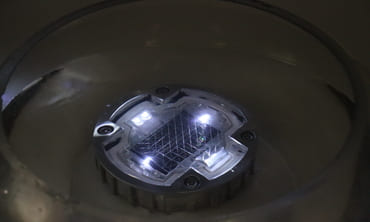
The RC-SRS-B2 (and its glass-housed variant RC-SRS-B3) uses a hemispherical lens design to emit light in all directions. This means that unlike unidirectional studs, it provides uniform visibility at intersections, roundabouts, and any complex lane layout. The driver’s headlights strike the stud from any side, and the LED (or reflective glass beads) bounces the light back everywhere. As noted, this 360° emission “maximises drivers’ guiding and warning” capabilities by illuminating the road ahead from every angle. In practice, a single RC-SRS-B2 at a curve’s apex will glow visible to traffic from multiple directions, dramatically improving lane delineation during nighttime traffic – an ideal feature for busy tourist roads or city crossroads.
RC-SRS-B2 models are engineered for heavy-duty use. With a static load rating over 20 tons (as per the product spec), the tempered glass structure can withstand traffic from heavy trucks and buses. In fact, many tempered glass studs boast >40-ton ratings, a level of strength far above most plastic units. This is critical for Thailand’s highways, which often see daily passage of 4-axle tour buses and freight trucks. The tempering process gives the glass exceptional hardness and impact resistance: even when studded on highways leading to Bangkok or Phuket, the glass housing resists crushing. By contrast, a typical polycarbonate stud might only handle ~10–15 tons safely, and could fracture under sustained weight. In summary, the RC-SRS-B2’s tempered glass shell ensures that heavy traffic does not compromise the device – a key selling point for infrastructure projects expecting long service life.
Thailand’s rainy season poses a challenge of water ingress and humidity. The RC-SRS-B2 is rated IP68 for waterproofing, meaning it can survive submersion and heavy flooding without failure. High-quality solar studs achieve this via rubber gaskets and fully encased glass lenses. Top-tier models keep all electronics sealed from moisture. In fact, testing shows that a proper IP68 stud remains dry inside even after days of rain. For Thailand’s torrential rains and occasional flash floods, this means the RC-SRS-B2 will keep shining. Even if the roads flood temporarily, the glass lens and housing prevent water from entering the battery or LEDs. This reliability in wet weather makes it suitable for Bangkok’s storm drainage, coastal highways (with salty spray), or rural areas with poor drainage. Overall, the combination of IP68 sealing and strong materials ensures minimal maintenance: the studs keep working through storms without the need for constant upkeep.
| Property | Tempered Glass | Polycarbonate (Standard) |
|---|---|---|
| Impact Resistance | High – withstands >20–40 tons, minimal deformation | Moderate – generally up to ~10–20 tons; can crack under heavy load |
| UV & Weather Stability | Excellent – does not fade or yellow in sunlight; resists scratches | Fair – may yellow, warp, or become brittle under UV over time |
| Temperature Tolerance | Very High – stable under 50–60°C surface heat | Lower – can soften or deform when surface temps exceed ~50°C |
| Lifespan | Long – typically 5–10+ years; long service life | Shorter – often 3–5 years before replacement needed |
| Maintenance | Minimal – self-cleaning dome, durable surface | Higher – may require cleaning and eventual replacement |
The evidence is clear: for Thai roads, solar glass road studs like the RC-SRS-B2 provide superior long-term performance. Their robust tempered glass housing withstands heat, heavy loads, and rain, while 360° LEDs boost night-time visibility on curves and intersections. This makes them a smart choice for safety upgrades in urban and tourist areas alike. As Thailand continues to prioritize renewable, low-maintenance infrastructure in its Smart City planning, these solar studs offer both technical and financial advantages.
.jpg)
.png)
.jpg)