When buyers search for "solar vs reflective road studs", they are usually choosing between two ways of marking a road at night: a stud that produces its own light, or a stud that returns the light of passing vehicles. The decision turns on road conditions, energy dependency, maintenance access and the evidence a supplier can provide, not on which technology sounds more advanced.
This article first clears up a common terminology mix-up, then compares how each type works, which project factors decide the fit, how to model total cost, and what to request from suppliers. It does not name a universal winner, because there isn't one.
Many comparisons set "LED road studs" against "solar road studs" as if they were rival products. They describe different things.
| Term | What it describes | Typical role in a road stud |
|---|---|---|
| LED | A light-emitting component | The emitter that produces visible light in an active stud |
| Solar | A power source | A solar panel that charges an energy storage component, such as a battery or supercapacitor |
| Reflective (passive) | Optics that return incoming light | Retroreflective elements that send headlight beams back toward the driver, with no power supply |
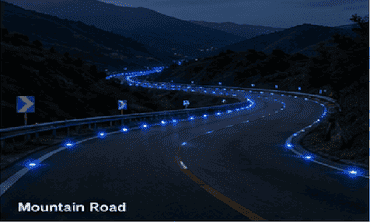
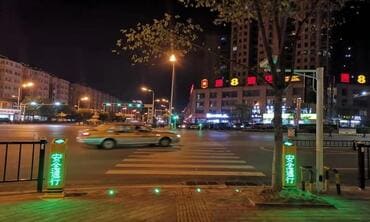
A solar road stud commonly uses LEDs, so "LED" and "solar" often describe the same product from two angles: one names the emitter, the other names where the energy comes from. The real contrast is between active studs, which emit light, and passive studs, which reflect it.
An LED stud does not have to be solar-powered in principle. If a supplier offers an LED unit with a different power arrangement, such as wired power, ask for exactly how it is powered and what that means for installation. Do not assume it behaves like a self-contained solar unit.
What makes a stud visible to a driver is different in each case, and that difference drives most of the other trade-offs.
A reflective stud depends on a vehicle's headlights reaching it at a suitable angle. An active solar stud depends on stored energy, so what matters is whether it is charged and which operating mode it is running.
| Aspect | Active solar stud | Passive reflective stud |
|---|---|---|
| How it becomes visible | LEDs emit light using stored solar energy | Retroreflective optics return headlight beams |
| Depends on vehicle headlights | Not for its own light output | Yes |
| Depends on charging and stored energy | Yes | No |
| Operating modes | May offer steady or flashing modes, depending on the model | Not applicable |
| Viewing geometry | Depends on the model's optical design | Depends on the reflector design and the angle to the headlights |
Ask each supplier to describe the construction and operating behaviour of the exact model. Treat any stated visibility distance as a claim tied to specific test conditions, not as a guarantee for your road. If a supplier offers a night-time comparison, ask under what conditions it was captured: the site, the weather, the viewing position and the vehicle lighting. A comparison without those details cannot be applied to your project.
Once the mechanisms are clear, the question becomes which factors in your project favour one type or the other.
Use the matrix below as a first screening. It describes when each type may fit, and it does not rank them.
| Project factor | Active solar stud may fit when… | Passive reflective stud may fit when… |
|---|---|---|
| Lighting and delineation need | The design calls for independent illumination on an unlit segment | The specification accepts delineation that relies on headlights |
| Sun exposure | Charging exposure at the site is adequate | Exposure is poor or uncertain |
| Maintenance access | Inspection and replacement of powered units can be planned | The project prefers units with no stored energy to manage |
| Budget structure | The project evaluates cost over a service period | The project is driven mainly by initial cost, subject to the specification |
| Tender requirements | The tender names or permits active markers | The tender names or permits reflective markers |
Both types must still meet the road authority's requirements for the segment. Neither choice should be presented to a client as a guaranteed safety outcome.
Not sure which category fits your road? Compare road stud options for your project by sending the lighting condition, speed and geometry, surface, quantity and target country, and we can suggest a suitable shortlist.
Unit price alone does not compare an active stud with a passive one. The two have different cost structures, so compare them over the same study period using your own figures.
Start from supplier quotations and your project's real assumptions: the study period, labour rates, traffic management costs and the maintenance approach. Where an input is unknown, leave it blank and say so rather than inserting a typical number.
A simple structure for each option over the same study period:
Total cost = purchase cost + installed labour + traffic management and closures + inspection + replacement units + battery or service items (if applicable) + end-of-life handling
| Cost item | Active solar stud | Passive reflective stud | Source of figure |
|---|---|---|---|
| Purchase cost (unit price × quantity) | Supplier quotation | ||
| Installed labour | Contractor estimate | ||
| Traffic management and closures | Project plan | ||
| Inspection | Maintenance plan | ||
| Replacement units | Supplier guidance and project assumptions | ||
| Battery or service items (if applicable) | Supplier documents | ||
| End-of-life handling | Local requirements |
Run the model with more than one set of assumptions, for example a shorter and a longer study period, or a higher and lower replacement rate. If the ranking changes between scenarios, that tells you which assumption matters most and which supplier evidence to request. Be wary of any source that promises a fixed saving or payback period without showing its inputs, because the result depends on your road, your labour costs and your maintenance regime.
When the comparison points to a category, move to a model-level review. If active markers are in scope, review the available solar road studs. If passive delineation is acceptable, review the reflective road studs. Not every model within a category suits every use, so match each shortlisted model to your requirement individually.
An RFQ for either type should state:
Keep the documents for each type separate. Reflector data describes a passive stud and says nothing about an active unit's LEDs, storage or charging, and the reverse is also true. Match every report to the exact model, version and test conditions. For a deeper look at how active studs are assessed after installation, see our notes on road stud durability and performance testing.
Ready for a side-by-side model comparison? Share your road lighting condition, speed and geometry, installation surface, quantity and target country through the project enquiry page and request a shortlist with the available technical documents.
No. LED is a light-emitting component, while solar describes a power source. A solar road stud commonly uses LEDs, so the two terms often describe the same product, but they are not alternatives to each other.
No. Passive reflective studs rely on vehicle headlights and retroreflective optics. Their visibility therefore depends on headlights reaching them at a suitable angle, and their performance depends on the reflector design and its condition.
Not universally. Visibility depends on the charge state, viewing angle, model, weather, installation and the conditions in which any comparison was tested. Ask suppliers for test conditions, not just a distance figure.
It depends on the project. Build a total-cost model using your own quotations, installation and maintenance assumptions and study period. A universal saving claim is not reliable.