The year 2026 marks a pivotal moment in the evolution of sustainable urban infrastructure, particularly in outdoor lighting. As cities and industrial estates increasingly adopt solar-powered solutions, the challenge of maintaining optimal efficiency has brought self-cleaning technology from a luxury to an absolute necessity. This guide addresses the critical issue of “Soiling Loss”—the significant reduction in solar panel output due to accumulated dust, sand, bird droppings, and other environmental debris. Such losses can drastically impact the performance and economic viability of solar street lights, especially in arid regions or areas with high pollution. We provide a comprehensive, expert-level technical buying guide for municipal maintenance departments, industrial estate managers, large-scale solar farm operators, and smart city developers on selecting self-cleaning solar street lights. We highlight the RUICHEN RC-LIGHT-UL Self-Cleaning Series as an industry-leading solution, engineered for maintenance-free, high-efficiency lighting that directly tackles the pain points of efficiency degradation and high manual cleaning costs.
Section 1: Solving the Core Pain Points of Infrastructure Managers
Infrastructure managers overseeing solar street light deployments face a unique set of operational and financial challenges, primarily stemming from environmental factors and maintenance logistics. Self-cleaning solar street lights are engineered to directly address these critical pain points.
The Dust & Sand Problem: Analyzing how a thin layer of dust can reduce panel output by up to 30-40% in arid regions.
One of the most significant threats to solar panel efficiency, particularly in arid and semi-arid regions, is the accumulation of dust, sand, and other particulate matter. This phenomenon, known as "soiling loss," can dramatically reduce a solar panel's energy output. Studies indicate that even a thin layer of dust can lead to a reduction in panel output by as much as 30-40% in arid regions [1]. This directly translates to reduced lighting performance, shorter battery life, and ultimately, a compromised public safety and security infrastructure. The RC-LIGHT-UL Self-Cleaning Series directly combats this by actively removing accumulated debris, ensuring consistent and optimal energy harvesting.
Manual Cleaning Costs: The financial and safety burden of using bucket trucks and labor for periodic cleaning.
To counteract soiling loss, traditional solar street lights require periodic manual cleaning. This process is not only labor-intensive and time-consuming but also carries significant financial and safety burdens. The deployment of specialized equipment like bucket trucks, coupled with the cost of skilled labor, makes manual cleaning an expensive endeavor. Furthermore, working at heights presents inherent safety risks for maintenance personnel. These operational expenditures can significantly inflate the Total Cost of Ownership (TCO) for solar lighting infrastructure. The RC-LIGHT-UL's automated self-cleaning mechanism eliminates the need for frequent manual interventions, drastically reducing these costs and associated risks.
Bird Droppings & Hot Spots: How localized shading leads to permanent cell damage and system failure.
Beyond dust and sand, localized shading caused by bird droppings, leaves, or other debris can create “hot spots” on solar panels. Hot spots occur when shaded cells draw power from unshaded cells, leading to overheating and potential permanent damage to the solar cells, ultimately resulting in system failure or significantly reduced lifespan. This localized degradation is particularly insidious as it can go unnoticed without regular inspection. The RC-LIGHT-UL’s self-cleaning mechanism proactively removes such localized obstructions, preventing hot spot formation and preserving the long-term integrity and performance of the solar panel.
Total Cost of Ownership (TCO): Why self-cleaning systems pay for themselves within 2-3 years through energy gains and labor savings.
The economic justification for self-cleaning solar street lights is compelling when considering the Total Cost of Ownership (TCO). While the initial investment might be slightly higher than conventional solar street lights, the long-term savings are substantial. By maintaining optimal panel efficiency, these systems maximize energy harvesting, leading to consistent lumen output and extended battery life. More importantly, the elimination of manual cleaning costs—including labor, equipment rental (e.g., bucket trucks), and associated safety measures—results in significant operational expenditure reductions. Industry analyses suggest that the energy gains and labor savings from self-cleaning mechanisms can lead to a payback period of just 2-3 years, making them a highly cost-effective solution over their operational lifespan [2].
Section 2: Material Science & Self-Cleaning Engineering
The effectiveness and longevity of self-cleaning solar street lights are deeply rooted in advanced material science and precision engineering. The RC-LIGHT-UL series exemplifies these advancements, integrating innovative solutions to ensure reliable, automated cleaning.
Robotic Wiper Mechanisms: The engineering of durable, weather-resistant brushes and high-torque motors.
At the heart of the self-cleaning system is the robotic wiper mechanism. This involves the meticulous engineering of durable, weather-resistant brushes designed to effectively sweep debris without scratching the solar panel surface. These brushes are typically driven by high-torque, low-power consumption motors that can operate reliably in diverse environmental conditions, from extreme heat to freezing temperatures. The RC-LIGHT-UL features a programmable auto-cleaning brush, indicating a sophisticated robotic wiper system capable of consistent and gentle cleaning cycles [3].
Nano-Coatings: The role of hydrophobic and anti-static coatings in preventing dust adhesion.
Complementing mechanical cleaning, advanced nano-coatings play a crucial role in preventing dust and dirt adhesion. Hydrophobic (water-repelling) coatings cause water droplets to bead up and roll off, carrying dirt particles with them, a phenomenon known as the "lotus effect." Anti-static coatings reduce the electrostatic attraction between dust particles and the panel surface, making it harder for dust to settle and easier for the robotic wiper to remove. While specific coating details for the RC-LIGHT-UL are not explicitly mentioned, such technologies are often integrated into high-end self-cleaning solar solutions to enhance cleaning efficiency and reduce frequency.
Housing Materials: Using high-grade aluminum alloys to protect the cleaning mechanics from extreme heat and sand abrasion.
The housing that encases the cleaning mechanics and other sensitive components must be as robust as the solar panel itself. High-grade aluminum alloys are frequently chosen for their excellent strength, corrosion resistance, and thermal dissipation properties. This material choice ensures that the internal robotic wiper mechanisms, motors, and electronics are protected from extreme temperatures, fine sand abrasion, and other environmental stressors. The RC-LIGHT-UL's durable aluminum alloy body provides this critical protection, contributing to the system's overall longevity and reliability.
Brush Durability: Selecting materials that clean effectively without scratching the solar glass over thousands of cycles.
The durability and material composition of the cleaning brushes are paramount. The brushes must be abrasive enough to effectively remove stubborn dirt and grime but gentle enough to prevent any micro-scratches on the solar glass, which could degrade panel performance over time. Manufacturers invest in research to select materials that maintain their cleaning efficacy over thousands of cycles without causing damage. The RC-LIGHT-UL's self-cleaning mechanism is designed for long-term operation, implying the use of such carefully selected, high-durability brush materials.
Section 3: The Intelligent Energy & Control Ecosystem
The RC-LIGHT-UL's self-cleaning functionality is seamlessly integrated into an intelligent energy and control ecosystem, ensuring that both lighting and cleaning operations are optimized for efficiency and reliability.
Automated Cleaning Schedules: Programming cycles based on local dust levels and weather patterns.
One of the key advantages of the RC-LIGHT-UL is its ability to implement automated cleaning schedules. These schedules can be programmed based on various factors, including historical data on local dust accumulation, real-time environmental sensor data (if integrated), and anticipated weather patterns. For instance, cleaning cycles can be intensified during dry, windy seasons prone to dust storms or after rainfall to remove mud residue. This intelligent scheduling ensures that cleaning occurs precisely when needed, maximizing energy harvesting and minimizing unnecessary power consumption by the cleaning mechanism.
Smart Sensing: Systems that detect efficiency drops and trigger an emergency cleaning cycle.
Advanced self-cleaning systems often incorporate smart sensing capabilities. These systems continuously monitor the solar panel's power output and can detect significant drops in efficiency, which typically indicate heavy soiling. Upon detecting such a drop, the system can automatically trigger an emergency cleaning cycle, ensuring that optimal performance is restored promptly. This proactive approach to maintenance is crucial for mission-critical applications where consistent lighting and energy generation are essential. While not explicitly detailed for the RC-LIGHT-UL, such smart features are characteristic of leading self-cleaning solar street lights.
Energy Storage: The necessity of high-cycle LiFePO4 batteries to power both the lighting and the cleaning mechanism.
The energy demands of both the LED lighting and the robotic cleaning mechanism necessitate a robust and reliable energy storage solution. The RC-LIGHT-UL utilizes high-cycle Lithium Iron Phosphate (LiFePO4) batteries, which are ideal for this dual role. LiFePO4 batteries offer a long lifespan (over 2000 charge/discharge cycles), excellent thermal stability, and consistent power delivery, ensuring that there is always sufficient energy to power the lighting throughout the night and to execute the cleaning cycles without compromising overall system performance. This integrated energy management is key to the RC-LIGHT-UL's maintenance-free operation.
Section 4: Durability Benchmarks for Extreme Environments
The RC-LIGHT-UL Self-Cleaning Series is engineered to perform reliably in the most challenging environmental conditions, meeting stringent durability benchmarks for extreme climates.
Desert Resilience: Performing in 50°C+ heat with fine sand infiltration.
Desert environments present a formidable challenge for outdoor electronics, characterized by extreme temperatures often exceeding 50°C and the pervasive presence of fine sand. The RC-LIGHT-UL is designed to exhibit exceptional desert resilience. Its robust housing materials and advanced thermal management systems protect internal components from heat-induced degradation. Furthermore, the self-cleaning mechanism is specifically engineered to handle fine sand infiltration, ensuring that solar panels remain clear and operational even after sandstorms, a critical feature for solar infrastructure in arid regions [3].
Coastal Protection: IP66/IP67 ratings and anti-corrosive treatments for salt-air environments.
Coastal regions expose outdoor equipment to high humidity and corrosive salt-laden air, which can rapidly degrade unprotected materials. The RC-LIGHT-UL boasts an IP66 waterproof rating, providing comprehensive protection against dust and powerful water jets, making it highly suitable for coastal deployment. Additionally, its high-grade aluminum alloy housing is treated with anti-corrosive finishes, safeguarding the system against the corrosive effects of salt air and ensuring long-term structural integrity and performance.
Wind Resistance: Ensuring the cleaning arm and panel structure can withstand high-velocity winds.
In many regions, high-velocity winds are a common occurrence, posing a significant risk to tall structures like street lights. The design of the RC-LIGHT-UL, including its cleaning arm and solar panel structure, is engineered to withstand substantial wind loads. This involves robust mounting systems, aerodynamic designs, and durable materials that prevent structural fatigue and failure, ensuring the system remains stable and operational even during severe weather events.
Section 5: 2026 Selection Criteria for B2B Buyers
For B2B buyers such as municipal maintenance departments and industrial estate managers, the selection of self-cleaning solar street lights in 2026 involves a detailed evaluation of several key performance and operational criteria.
Cleaning Frequency & Efficiency: Evaluating the effectiveness of the cleaning sweep.
A primary criterion for self-cleaning systems is the effectiveness of their cleaning mechanism. Buyers must evaluate the cleaning frequency—how often the system performs a sweep—and its efficiency—how thoroughly it removes various types of debris. The RC-LIGHT-UL's programmable auto-cleaning brush allows for flexible scheduling, which can be optimized to maintain maximum panel efficiency based on local environmental conditions. A highly efficient cleaning sweep directly translates to consistent energy generation and reliable lighting performance.
Mechanical Longevity: What to look for in motor life and brush replacement intervals.
The mechanical components of a self-cleaning system, particularly the motor and brushes, are subject to wear and tear. Buyers should inquire about the expected lifespan of the motor and the recommended replacement intervals for the cleaning brushes. High-quality systems, like the RC-LIGHT-UL, are designed with durable components to minimize maintenance. A long motor life and extended brush replacement intervals contribute significantly to a lower Total Cost of Ownership and reduced operational disruptions.
Regulatory Compliance: Certifications for electrical safety and mechanical reliability in public spaces.
Deployment in public spaces necessitates strict adherence to regulatory standards. Buyers must ensure that the self-cleaning solar street light system holds relevant certifications for electrical safety (e.g., CE, RoHS, UL) and mechanical reliability. These certifications provide assurance that the product meets established safety and performance benchmarks, crucial for public infrastructure projects. RUICHEN Traffic's commitment to quality suggests their products meet or exceed these critical regulatory requirements.
Product Spotlight: RUICHEN RC-LIGHT-UL Self-Cleaning Series
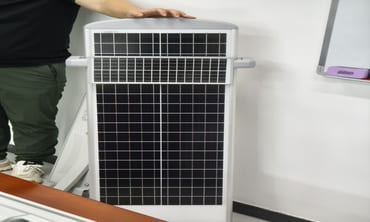
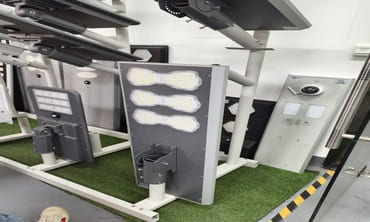
The RUICHEN RC-LIGHT-UL Self-Cleaning Series stands as a testament to innovation in solar street lighting, specifically designed to address the pervasive challenges of soiling loss and high maintenance costs. It integrates cutting-edge self-cleaning technology with robust solar lighting, offering an unparalleled solution for demanding urban and industrial environments.
Key Features and Robotic Cleaning Technology:
- Automated Self-Cleaning Brush: A programmable robotic wiper mechanism that actively sweeps the solar panel surface, effectively removing dust, sand, and debris to maintain optimal efficiency.
- High-Efficiency Monocrystalline Solar Panels: With over 21% conversion efficiency, these panels ensure rapid energy harvesting, supported by the continuous cleaning action.
- Advanced LiFePO4 Battery: A high-cycle Lithium Iron Phosphate battery provides reliable power for both lighting and the cleaning mechanism, ensuring 365 days of operation with smart modes.
- Patented PRO-DOUBLE MPPT Controller: Optimizes energy conversion and intelligently manages power distribution, ensuring consistent performance.
- Durable Aluminum Alloy Body: Provides robust protection for all internal components, including the cleaning mechanism, against extreme weather and physical impact.
- IP66 Waterproof Rating: Guarantees comprehensive protection against dust and powerful water jets, crucial for outdoor reliability.
- Integrated Lightning Resistance: Enhances system durability and safety by protecting against electrical surges.
- Smart APP Control: Allows for remote monitoring and customization of lighting and cleaning schedules, offering flexible management.
The RC-LIGHT-UL's design philosophy centers on maximizing operational uptime and minimizing human intervention. Its robotic cleaning technology ensures that the solar panels consistently operate at peak efficiency, translating into brighter illumination, longer battery life, and significant savings on maintenance. This series is an ideal choice for infrastructure managers seeking a truly maintenance-free and high-performance solar lighting solution.
Direct Link: Explore the RC-LIGHT-UL Self-Cleaning Solar Street Light here.
Section 6: Economic Impact & ROI Analysis
The economic benefits of deploying the RUICHEN RC-LIGHT-UL Self-Cleaning Series extend far beyond initial cost considerations, offering a compelling return on investment (ROI) through enhanced efficiency and reduced operational expenditures.
Comparative analysis: Manual cleaning vs. Automated self-cleaning over a 10-year period.
A direct comparison between manual and automated self-cleaning reveals significant long-term savings. Over a 10-year period, the cumulative costs associated with manual cleaning—including labor, equipment rental, and potential safety incidents—can be substantial. Automated self-cleaning, while requiring a slightly higher upfront investment, virtually eliminates these recurring costs. The consistent optimal performance of self-cleaned panels also translates to greater energy generation, further enhancing the financial returns. Studies and real-world data consistently show that self-cleaning systems offer a superior ROI, often paying for themselves within 2-3 years through these combined savings and efficiency gains [2].
The value of consistent lumen output for public safety.
Beyond financial metrics, the consistent lumen output provided by a self-cleaning solar street light has an invaluable impact on public safety. Optimal illumination levels are critical for deterring crime, enhancing visibility for pedestrians and drivers, and improving overall urban security. Soiling loss directly compromises this, leading to dimmer lights and reduced safety. The RC-LIGHT-UL, by ensuring its solar panels are always clean and operating at peak efficiency, guarantees consistent and reliable illumination, thereby directly contributing to a safer and more secure public environment.
Conclusion: Future-Proofing Your Urban Lighting
The RUICHEN RC-LIGHT-UL Self-Cleaning Series represents a paradigm shift in solar street lighting, offering a future-proof solution that addresses the core challenges of efficiency, durability, and maintenance. By integrating advanced robotic cleaning technology with high-performance solar components, it provides a sustainable, cost-effective, and reliable lighting infrastructure for smart cities, industrial estates, and large-scale projects. This guide underscores the strategic value of automated maintenance in 2026, positioning the RC-LIGHT-UL as an essential investment for infrastructure managers seeking to maximize efficiency and minimize operational burdens.
For municipal tenders, project quotes, and distribution partnerships, RUICHEN Traffic invites you to connect directly to explore how the RC-LIGHT-UL can revolutionize your urban lighting infrastructure.
Massive FAQ Section
Q: How often does the brush need replacement?
A: The brushes in the RC-LIGHT-UL's self-cleaning mechanism are designed for long-term durability. While specific replacement intervals can vary based on environmental conditions and usage frequency, they are engineered to withstand thousands of cleaning cycles. It is recommended to consult RUICHEN Traffic's technical specifications or maintenance guidelines for precise replacement schedules.
Q: Does the cleaning consume much battery power?
A: The robotic cleaning mechanism is designed for energy efficiency, utilizing low-power consumption motors. The intelligent energy management system, powered by the LiFePO4 battery, ensures that cleaning cycles are executed without significantly impacting the overall power reserves for lighting. Cleaning operations are typically brief and infrequent enough to have minimal impact on battery life.
Q: Can it clean bird droppings?
A: Yes, the robust design of the robotic wiper mechanism and the chosen brush materials are effective in removing various types of debris, including bird droppings. Regular cleaning cycles prevent such localized soiling from hardening and causing hot spots, ensuring the panel remains clear and efficient.
Q: What happens during a sandstorm?
A: The RC-LIGHT-UL is built with desert resilience in mind. During a sandstorm, the durable housing protects the internal components. After the storm subsides, the automated self-cleaning mechanism can be programmed to activate, quickly removing accumulated sand from the solar panel surface, restoring its full charging capability and preventing long-term efficiency loss.
Q: What is the lifespan of the RC-LIGHT-UL's self-cleaning mechanism?
A: The self-cleaning mechanism, including its motor and brushes, is engineered for longevity, mirroring the overall durability of the RC-LIGHT-UL. Designed to operate reliably over thousands of cycles, its lifespan is intended to align with the extended operational life of the solar panels and battery, minimizing the need for frequent component replacements.
Q: How does the self-cleaning feature impact the warranty?
A: The self-cleaning feature is an integral part of the RC-LIGHT-UL's design, intended to enhance its performance and longevity. It typically does not negatively impact the warranty; rather, it helps maintain the solar panel's efficiency, which can contribute to upholding warranty conditions related to power output. Specific warranty details should always be confirmed with RUICHEN Traffic.
Q: Can the cleaning schedule be manually overridden?
A: Yes, with smart APP control, users typically have the flexibility to manually override automated cleaning schedules. This allows for on-demand cleaning if a sudden accumulation of debris is observed or for specific maintenance requirements, providing full control over the system's operation.
Q: Is the self-cleaning mechanism noisy?
A: The robotic wiper mechanisms are generally designed to operate quietly, especially given their deployment in public spaces. Manufacturers prioritize low-noise operation to minimize disturbance. For specific noise levels, consulting the product's technical specifications or contacting RUICHEN Traffic directly would provide precise information.
Q: What kind of maintenance is still required for a self-cleaning street light?
A: While the self-cleaning feature significantly reduces maintenance, some periodic checks are still recommended. This might include visual inspections of the overall unit, checking battery health (remotely via smart control), and ensuring the cleaning brushes are in good condition. These interventions are far less frequent and less intensive than manual panel cleaning.
Q: How does the RC-LIGHT-UL handle snow accumulation?
A: While primarily designed for dust and sand, the self-cleaning mechanism can also assist with light snow accumulation. For heavier snowfalls, the angle of the solar panel and the dark color of the panel itself can help with natural melting. However, in regions with very heavy and persistent snow, additional snow removal strategies might be considered, though the self-cleaning feature still provides a significant advantage over non-cleaning panels.
Q: What are the environmental benefits of self-cleaning solar street lights?
A: Self-cleaning solar street lights enhance environmental benefits by ensuring consistent energy generation from renewable sources, reducing the need for grid electricity. They also minimize the environmental impact associated with manual cleaning operations, such as vehicle emissions from maintenance trucks and the use of water (if wet cleaning methods were employed). This contributes to a lower carbon footprint and more sustainable urban infrastructure.
Q: Can the self-cleaning feature be retrofitted to existing RC-LIGHT-UL units?
A: The self-cleaning mechanism is an integrated feature of the RC-LIGHT-UL Self-Cleaning Series. Retrofitting this complex robotic system to existing non-self-cleaning units is generally not feasible due to design differences in the panel structure, housing, and control systems. It is best to purchase units specifically designed with the self-cleaning capability.
Q: How does the RC-LIGHT-UL's self-cleaning compare to other market solutions?
A: The RC-LIGHT-UL distinguishes itself with its patented PRO-DOUBLE MPPT controller, robust aluminum alloy body, IP66 rating, and a programmable auto-cleaning brush. This combination of high-efficiency energy management, extreme durability, and intelligent automated cleaning positions it as a leading solution in the market, particularly for environments where soiling is a significant challenge. Its integrated design aims for maximum uptime and minimal human intervention.
Q: What is the power source for the cleaning mechanism?
A: The cleaning mechanism is powered by the same integrated LiFePO4 battery that powers the street light. The intelligent energy management system ensures that the power consumption for cleaning is optimized and does not compromise the primary function of lighting, especially during critical operational hours.
Q: Are there any safety features for the cleaning mechanism?
A: Safety features for robotic cleaning mechanisms typically include sensors to detect obstructions, preventing damage to the mechanism or the panel. The system is designed to operate safely in public environments, with the cleaning cycles often scheduled during off-peak hours or when human presence is minimal. Specific safety protocols would be detailed in the product's operational manual.
.png)