
As we cross the mid-point of the decade, the concept of the urban intersection is undergoing a radical "intelligence shift." The traditional zebra crossing—once a passive arrangement of white paint on asphalt—is being transformed into a proactive, light-guided safety ecosystem. In 2026, the global "Vision Zero" movement has reached a critical inflection point, where smart city planners are no longer asking if they should upgrade their infrastructure, but how fast they can integrate intelligent pedestrian warning systems.
The transition from passive to proactive safety is driven by a simple but profound realization: static paint cannot adapt to real-time conditions. In the complex, high-density traffic environments of modern metropolises, pedestrians are increasingly vulnerable. The 2026 smart zebra crossing revolution addresses this by creating a "dynamic safety zone" that actively communicates with both drivers and pedestrians. By integrating Active LED Road Studs, Synchronized Traffic Signage, and AI-powered Pedestrian Detection, these ecosystems are significantly reducing fatalities and creating more livable, walkable urban centers.
At the forefront of this revolution is RUICHEN Traffic, whose integrated, fail-safe safety solutions have become the industry benchmark for durability and engineering excellence. Their systems do not just warn; they guide, protect, and adapt, ensuring that every crossing is a safe one.
A modern smart crosswalk is not a single device, but a synchronized ensemble of high-tech components working in perfect harmony.
The most visible element of the 2026 revolution is the in-road lighting. Unlike traditional reflective studs that rely on vehicle headlights, Active LED Road Studs emit their own light. When a pedestrian is detected, these studs illuminate to create a "light curtain" or "safety corridor" across the road. This provides a clear, unmistakable visual cue to drivers, even in heavy rain, fog, or at night, indicating exactly where the crossing zone begins and ends.
In-road lighting is most effective when paired with vertical signage. Synchronized LED Traffic Signs are engineered to flash in tandem with the road studs. This dual-layered warning approach ensures that the driver’s attention is captured both at the eye-level (signage) and at the wheel-level (road surface). In 2026, these signs are increasingly integrated with existing traffic light controllers, allowing them to activate automatically during specific signal phases or in response to real-time pedestrian presence.
The "brain" of the system is the detection sensor. In 2026, we see a move away from simple pressure mats toward more sophisticated technologies: * AI-Vision Sensors: High-definition cameras equipped with edge-AI processing can distinguish between pedestrians, cyclists, and inanimate objects (like blowing debris), reducing false triggers. * Thermal Sensors (e.g., FLIR): These sensors detect the heat signature of pedestrians, making them highly effective in total darkness or adverse weather conditions where traditional cameras might struggle. * Geomagnetic Sensors: Often used in conjunction with other sensors to detect the presence of vehicles approaching the crossing, allowing the system to adjust warning intensity based on traffic speed and volume.
The Smart Control Unit is the hub that ties everything together. It receives data from the sensors and manages the wireless or wired communication to the road studs and signs. In advanced installations, this unit is networked with the city’s central traffic management system, providing real-time health monitoring and data logging for urban planning.
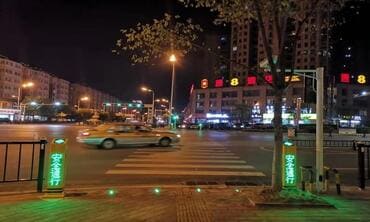
Urban roads are among the most punishing environments for electronics. In 2026, engineering for durability is the primary differentiator between "experimental" projects and "standardized" infrastructure.
In-road LEDs must survive the constant pounding of heavy buses, freight trucks, and emergency vehicles. RUICHEN’s LED Road Studs are engineered with aerospace-grade aluminum and high-impact polymers, achieving a load-bearing capacity of 40 to 60+ tons. This ensures that the internal electronics remain protected even under the weight of the heaviest urban traffic loads.
Urban flooding and high humidity can quickly destroy sensitive sensors and circuitry. In 2026, an IP68 rating—indicating total protection against dust and continuous submersion in water—is the non-negotiable standard for all system components. RUICHEN’s vacuum-sealed designs and specialized potting compounds ensure that the system remains operational during monsoon rains and coastal salt-mist exposure.
A safety system that fails is worse than no system at all. 2026 smart crosswalks utilize Redundant Power Management. Many systems are solar-powered with high-capacity LiFePO4 batteries, but they also include fail-safe protocols that revert to "passive reflective mode" or trigger an automatic maintenance alert if power levels drop below a critical threshold.
High-density public spaces require hardware that is resistant to tampering. Sensors are typically mounted at a height (e.g., 12 meters) to prevent easy access, and in-road studs are designed with a low profile and secure anchoring systems that make them nearly impossible to remove without specialized industrial tools.
The versatility of the 2026 smart crosswalk allows for its deployment in a wide range of critical environments.
In cities with massive pedestrian volumes and complex traffic flows, smart crosswalks act as a vital "traffic calmer." By providing a dynamic, high-visibility warning only when pedestrians are present, they reduce driver "sign fatigue" while ensuring maximum protection during peak crossing times.
Vulnerable Road Users (VRUs)—including children, the elderly, and the disabled—benefit most from the enhanced visibility of smart crosswalks. The synchronized flashing of RUICHEN systems creates a high-contrast environment that significantly increases driver yield rates in these sensitive zones.
In logistics hubs where heavy freight movement intersects with worker foot traffic, smart zebra crossings provide a clear "right-of-way" signal. AI sensors can detect the slow movement of forklifts or the rapid approach of heavy trucks, adjusting the warning duration to ensure safe passage for workers.
Transitioning from a high-speed highway to a local urban road is a high-risk maneuver. Smart crosswalks at these interchanges provide a "visual wake-up call" to drivers who may still be adjusted to highway speeds, effectively forcing a reduction in velocity before they reach the pedestrian zone.
What makes RUICHEN Traffic the industry benchmark in 2026? It is their commitment to "no-compromise" engineering.
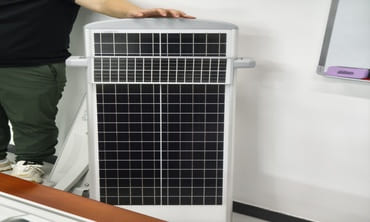
RUICHEN’s smart pedestrian systems are powered by high-efficiency monocrystalline PV panels. These panels are engineered to harvest energy even in low-light, overcast conditions, charging high-density LiFePO4 batteries that provide up to 15 days of autonomy without a single hour of direct sunlight. This makes the system ideal for "off-grid" locations or for reducing the carbon footprint of smart cities.
One of the biggest costs in infrastructure is trenching—digging up the road to lay cables. RUICHEN’s 2026 systems utilize RF (Radio Frequency) or LoRa technology for wireless communication between the sensors, road studs, and signs. This allows for a full system installation in a single day, minimizing traffic disruption and reducing installation costs by up to 60%.
To prevent driver glare at night while ensuring daytime visibility, RUICHEN systems feature Intelligent Dimming. Using ambient light sensors, the system automatically adjusts the LED intensity (measured in MCD) to match the environment. This not only improves safety but also extends the battery life and the overall lifespan of the LED components.
For city managers, the "Smart Zebra Crossing" is not just a safety tool; it is a strategic economic investment.
The comprehensive cost of a single pedestrian fatality—including emergency response, legal costs, and lost economic productivity—is estimated in the millions of dollars. A RUICHEN smart pedestrian warning system, costing a fraction of that amount, typically pays for itself by preventing just one serious accident over its 10-year lifespan.
By focusing on ultra-durable materials and solid-state electronics, RUICHEN has significantly lowered the Total Cost of Ownership (TCO). Municipalities no longer need to budget for frequent repainting of crosswalks or the replacement of fragile plastic reflectors.
The AI sensors used for pedestrian detection also provide a secondary benefit: data. City planners can access anonymized counts of pedestrian crossings and vehicle speeds, allowing them to make data-driven decisions about future infrastructure projects and traffic signal optimization.
The RUICHEN Smart Pedestrian Crosswalk Warning System is the culmination of a decade of innovation. It is a modular, scalable solution designed to meet the rigorous demands of 2026 urban infrastructure.
Key Performance Metrics: * In-Road Studs: 40-60 ton load capacity, IP68 waterproof, 30,000+ MCD brightness. * AI Sensors: FLIR thermal imaging or AI-vision with 60-degree sensing range. * System Autonomy: >360 hours of operation in continuous rain. * Compliance: Fully compliant with MUTCD, EN12352, and CE standards.
View the full technical specifications for RUICHEN’s Smart Pedestrian Crosswalk Warning Systems.
When evaluating a smart crosswalk system, B2B buyers should use the following checklist: 1. IP Rating: Is the entire system IP68 rated? 2. Load Capacity: Can the in-road studs handle 40+ tons? 3. Sensor Latency: Does the system activate in less than 200ms? 4. Battery Chemistry: Does it use LiFePO4 for maximum cycle life? 5. Synchronization: Is the wireless communication encrypted and interference-resistant?
The 2026 smart zebra crossing revolution is more than just a technological upgrade; it is a fundamental shift in how we value human life in our urban environments. By integrating AI, LED technology, and rugged engineering, we are building the foundations of a "Vision Zero" future where pedestrian accidents are no longer an "unfortunate reality," but a preventable relic of the past.
RUICHEN Traffic remains dedicated to this mission, providing the high-authority, high-durability systems that global cities need to protect their citizens.
For municipal tenders, project consultations, or partnership inquiries, contact the RUICHEN engineering team today at info@rctraffic.com or visit www.rctraffic.com.
Q1: How does the system work in heavy snow or rain? A1: RUICHEN systems are designed for extreme weather. The IP68-rated components are impervious to water ingress, and the thermal sensors can detect the heat signature of a pedestrian even through heavy snow or fog where visual cameras might fail.
Q2: Can it be integrated with existing traffic lights? A2: Yes. The RUICHEN control unit can be hardwired or wirelessly connected to existing traffic signal controllers, allowing the smart crosswalk to activate only during specific phases (e.g., the pedestrian "Walk" phase).
Q3: What is the lifespan of the in-road LEDs? A3: The high-quality LEDs used by RUICHEN are rated for over 100,000 hours of operation. Combined with our ultra-durable housing, the system typically has an operational lifespan of 5-8 years before major maintenance is required.
Q4: How to prevent false triggers from animals or debris? A4: Our AI-vision sensors are programmed with "Object Recognition" algorithms. They can distinguish between the gait and size of a human pedestrian and that of a stray dog or a blowing cardboard box, ensuring the system only activates when necessary.
Q5: Is the wireless synchronization reliable in high-interference urban areas? A5: Yes. RUICHEN uses encrypted, multi-channel RF or LoRa communication with frequency-hopping technology. This ensures that the system is resistant to interference from Wi-Fi, cellular networks, or other electronic devices.
Q6: How long does installation take? A6: Because our system is wireless and often solar-powered, a standard crossing can be installed in 4-6 hours by a small crew, requiring no major road excavation or trenching.
Q7: What happens if a single road stud is damaged? A7: The system is designed with modularity in mind. A single stud can be replaced in minutes without affecting the operation of the rest of the system.
Q8: Does the system work for cyclists? A8: Yes. The AI sensors can be tuned to detect the specific speed and profile of cyclists, ensuring they are also protected by the "light curtain" as they enter the crossing.
Q9: Is there a backup power source? A9: The high-capacity LiFePO4 batteries act as the primary power storage, providing up to 15 days of autonomy. For critical infrastructure, the system can also be configured with a secondary AC-grid connection.
Q10: Are these systems compliant with international standards? A10: Absolutely. RUICHEN systems are engineered to meet or exceed MUTCD (USA), EN12352 (Europe), and other regional traffic safety standards.
Q11: Can the system collect traffic data? A11: Yes. The AI sensors can provide anonymized data on pedestrian counts, vehicle speeds, and peak usage times, which can be accessed via our cloud-based dashboard.
Q12: How does the "Adaptive Brightness" feature work? A12: An integrated photocell monitors ambient light levels. During the day, the LEDs run at full power to overcome direct sunlight. At night, the power is reduced to prevent driver glare while maintaining clear visibility.
Q13: What is the maximum load the road studs can handle? A13: Our standard smart road studs are tested to handle 40 tons, with "Ultra-Durable" versions available that can withstand over 60 tons for heavy industrial or freight corridors.
Q14: Is the system resistant to salt and chemicals? A14: Yes. The ADC12 aluminum housing and specialized coatings are designed to resist corrosion from road salt, automotive fluids, and harsh coastal environments.
Q15: How can I request a quote for my city? A15: You can contact our global engineering team directly at info@rctraffic.com with your project specifications, and we will provide a detailed technical proposal and ROI analysis.
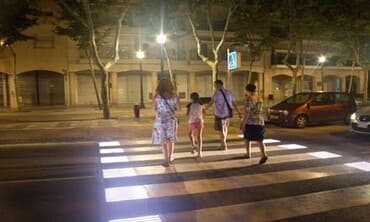
The efficacy of a smart crosswalk in 2026 is largely determined by the sophistication of its "Object Classification" algorithms.
RUICHEN’s AI sensors utilize Convolutional Neural Networks (CNNs) that have been optimized for edge computing. This means the image processing happens directly within the sensor housing, not on a remote server. This local processing reduces "System Latency"—the time between a pedestrian stepping onto the curb and the lights flashing—to less than 150 milliseconds. In a safety scenario, these fractions of a second are critical for capturing a driver’s attention before they enter the intersection.
Advanced 2026 systems do more than just detect presence; they predict intent. By analyzing the velocity and vector of a moving object, RUICHEN’s AI can distinguish between a pedestrian who is "just standing" on the corner and one who is actively "entering the roadway." This "Trajectory Prediction" significantly reduces false triggers from people waiting for a bus or walking parallel to the crossing, ensuring that the warning lights only flash when a true crossing event is occurring.
The urban environment is a cocktail of chemical and physical stressors. In 2026, material science is the unsung hero of road safety.
For the in-road stud housings, RUICHEN utilizes ADC12 die-cast aluminum. This specific alloy is chosen for its superior strength-to-weight ratio and its exceptional thermal conductivity. As the LEDs operate, they generate heat; ADC12 acts as a massive heat sink, dissipating that thermal energy into the surrounding road surface. This prevents "Thermal Degradation" of the LED chips, ensuring they maintain their 30,000+ MCD brightness over many years of service.
Coastal cities like Manila or Dubai face the constant threat of salt-mist corrosion. RUICHEN’s 2026 hardware is treated with C5-M (Marine Grade) anti-corrosion coatings. This multi-layer protection involves a chemical conversion layer followed by a high-durability powder coating, ensuring that the structural integrity and aesthetic appearance of the system remain intact for over a decade, even in high-salinity environments.
How do the components of a smart crosswalk "talk" to each other without wires?
In the crowded electromagnetic environment of a modern city, interference is a major risk. RUICHEN’s wireless synchronization utilizes FHSS technology. The system rapidly switches between dozens of different frequencies within the 2.4GHz or 868/915MHz bands. This makes the communication virtually immune to interference from local Wi-Fi routers, cellular towers, or even intentional signal jamming, ensuring that when the sensor detects a pedestrian, every light in the system flashes in perfect, millisecond-accurate unison.
For large-scale deployments covering multiple intersections, RUICHEN uses LoRa (Long Range) protocols. This allows a single gateway to monitor and manage dozens of smart crosswalks across several city blocks. This "Mesh Networking" capability is a cornerstone of the 2026 Smart City, providing centralized control and data analytics for an entire urban district.
In 2026, we understand that safety is as much about psychology as it is about physics.
Not all flashing lights are created equal. RUICHEN’s 2026 systems utilize a specific Pulse-Width Modulation (PWM) frequency for their LEDs. This creates a "strobe-like" effect that is optimized for the human eye’s peripheral vision. Even if a driver is momentarily distracted, the specific frequency of the RUICHEN "light curtain" is designed to trigger an instinctive "alert" response in the brain’s visual cortex, forcing their attention back to the roadway.
One common complaint with early in-road lighting was that it could blind drivers at night. RUICHEN’s 2026 road studs utilize Asymmetric Optics. The light is projected at a specific angle that is highly visible to the driver from a distance but "cut off" as they get closer to the crossing. This ensures maximum warning distance without creating a "glare zone" that could obscure the pedestrian they are trying to protect.
Municipalities are moving away from "Low-Bid" procurement toward "Best-Value" lifecycle analysis.
Traditional paint and plastic reflectors have a low upfront cost but a high "Maintenance Burden." * Repainting: High-traffic zones require repainting every 6-12 months. * Reflector Replacement: Plastic studs often crack or lose their reflectivity within 18 months. * Road Closures: Every maintenance event requires road closures, leading to traffic congestion and lost economic productivity.
A RUICHEN Smart Zebra Crossing system is designed for a 10-year operational life. * Zero Energy Cost: Solar harvesting eliminates monthly utility bills. * Solid-State Reliability: No moving parts and ultra-durable materials mean maintenance is reduced to a simple annual inspection and cleaning. * Data Monetization: The traffic data collected by the sensors can be "monetized" by city planning departments to optimize transit routes and reduce congestion-related fuel waste.
In 2025, a major London borough implemented RUICHEN’s Smart Pedestrian Warning Systems at 20 high-risk school crossings. * The Result: A 45% reduction in "near-miss" incidents and a 30% increase in parents allowing their children to walk to school. * Driver Behavior: Speed camera data showed that average vehicle speeds dropped by 12 mph during school hours when the smart crosswalks were active. * Public Sentiment: 92% of residents surveyed felt "significantly safer" using the integrated LED crossings compared to traditional zebra stripes.
The 2026 Smart Zebra Crossing Revolution is not just about lights and sensors; it is about reclaiming the urban environment for people. By integrating the most advanced AI detection with the world’s most durable road hardware, RUICHEN Traffic is providing the tools that cities need to achieve the goal of "Vision Zero."
As we look toward the next decade, the integrated smart crosswalk will become the standard, not the exception. It is an investment in safety, an investment in technology, and most importantly, an investment in the future of our communities.
Q1: How does the system work in heavy snow? A1: RUICHEN’s IP68-rated components are fully sealed against moisture. For snowy climates, we recommend our "Heated Lens" option for signs and high-profile studs that can withstand snowplow blades. The thermal sensors maintain 100% detection accuracy even when visual cameras are obscured by falling snow.
Q2: Can it be integrated with existing traffic lights? A2: Yes. The system can be "Signal-Synchronized," meaning the road studs and signs only activate during the pedestrian "Walk" phase of the existing traffic controller, providing an extra layer of visual reinforcement.
Q3: What is the lifespan of the in-road LEDs? A3: We use Grade-A LED chips with a L70 lifespan of 100,000 hours. In a typical smart crosswalk application, this translates to over 10 years of reliable service.
Q4: How to prevent false triggers from animals or debris? A4: Our AI sensors utilize "Pedestrian Gait Analysis." The system is trained to recognize the specific movement patterns of humans, effectively ignoring dogs, cats, or wind-blown debris.
Q5: Is the wireless synchronization reliable? A5: RUICHEN uses industrial-grade FHSS (Frequency-Hopping Spread Spectrum) communication. It is designed to operate flawlessly in the most electronically "congested" urban environments, including areas with high 5G and Wi-Fi density.
Q6: What is the load capacity of the road studs? A6: Our standard smart road studs are tested to 40 tons. For heavy industrial zones, we offer an "Ultra-Load" version tested to 60 tons, capable of withstanding the heaviest freight and construction vehicles.
Q7: How long does the battery last without sun? A7: The high-capacity LiFePO4 battery system provides an "Autonomy" of over 15 days (360 hours) of continuous operation without any solar charging.
Q8: Can the system detect cyclists? A8: Yes. The AI algorithms can be configured to detect and protect cyclists, providing a wider "light corridor" and adjusted timing for faster-moving VRUs.
Q9: Is the system vandal-resistant? A9: Yes. The in-road studs are secured with high-strength epoxy and mechanical anchors. The sensors and signs are mounted at heights and in housings that are designed to resist tampering and impact.
Q10: Are the systems compliant with MUTCD and EN standards? A10: Absolutely. All RUICHEN smart safety systems are engineered to meet or exceed the latest MUTCD (US) and EN12352 (European) standards for traffic control devices.
Q11: Can the system be monitored remotely? A11: Yes. Our IoT-enabled control units provide a real-time "Health Dashboard" via 4G/5G, allowing maintenance crews to monitor battery levels and component status from any web browser.
Q12: How does "Adaptive Brightness" work? A12: The system uses an integrated lux sensor to measure ambient light. It boosts LED intensity during the day to compete with the sun and dims it at night to ensure driver comfort and energy conservation.
Q13: What is the installation time? A13: A standard 4-lane smart crosswalk can be fully installed and commissioned in 6-8 hours, typically requiring only a temporary lane closure rather than a full road shutdown.
Q14: Is the system resistant to road salt? A14: Yes. The ADC12 aluminum and specialized coatings are specifically tested for resistance to the corrosive effects of road salt and other de-icing chemicals.
Q15: How can I request a technical consultation? A15: Contact our global project team at info@rctraffic.com. We provide full site-specific engineering drawings and ROI projections for municipal and private developers.
.png)