
As we navigate through 2026, the landscape of global road safety has undergone a fundamental transformation. The era of passive, static traffic signage is rapidly being eclipsed by a new generation of intelligent, energy-autonomous infrastructure. In this context, solar traffic signs are no longer viewed as "optional" upgrades for remote areas; they have become essential components of the modern Smart City ecosystem.
The shift is driven by the necessity for proactive safety measures. Traditional signs rely on vehicle headlights for visibility, which often fails in adverse weather or complex urban environments. In contrast, 2026-grade solar signs utilize high-intensity LEDs and data-responsive control systems to provide visibility that is active, adaptive, and reliable. This guide serves as a technical roadmap for road safety engineers, municipal procurement officers, and infrastructure project managers, helping them navigate the complexities of material science, energy management, and long-term durability in the quest for zero-fatality roadways.
At the forefront of this revolution is RUICHEN Traffic, a global leader that has redefined the reliability standard for solar signage. By solving the historical engineering pain points of downtime and degradation, RUICHEN has established a benchmark for what 2026 infrastructure should be: resilient, intelligent, and cost-effective.
For decades, road authorities have been hesitant to fully commit to solar technology due to three primary "pain points": reliability during bad weather, high maintenance costs, and complex regulatory compliance. In 2026, these issues have been systematically addressed through engineering innovation.
One of the most significant criticisms of early solar signage was its tendency to fail after three or four consecutive days of heavy rain or overcast skies. In regions like Southeast Asia or Northern Europe, this "downtime" occurred exactly when the signs were needed most—during low-visibility weather.
The 2026 solution lies in Advanced Energy Management Systems (AEMS). Modern signs, such as those in RUICHEN's high-performance series, utilize AI-driven MPPT (Maximum Power Point Tracking) controllers. These systems do not just "charge" the battery; they manage the energy budget. By analyzing historical weather data and current battery levels, the controller can dynamically adjust LED brightness or flashing frequency. This ensures that even during a 10-day monsoon, the sign remains operational, albeit at a slightly reduced (but still compliant) intensity, rather than failing entirely.
Municipalities often fall into the trap of evaluating traffic signs based on the initial "Price per Unit." However, the true cost of a sign is its Total Cost of Ownership (TCO) over a 10-year lifecycle. Budget signs often require battery replacements every 18 months and housing repairs due to UV-induced brittleness or moisture ingress.
In 2026, the industry has shifted toward "Zero-Maintenance" engineering. By utilizing LiFePO4 (Lithium Iron Phosphate) batteries and marine-grade ADC12 aluminum housings, the service interval for a high-quality solar sign has been extended to 5-8 years. When you factor in the cost of bucket truck rentals, road closures, and labor for each maintenance visit, a premium RUICHEN sign typically pays for itself within the first three years compared to a "budget" alternative.
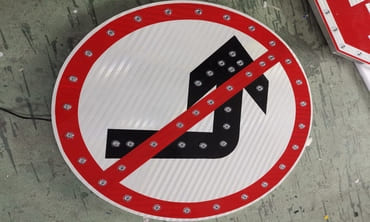
As traffic technology evolves, so do the standards. In 2026, compliance with the MUTCD (11th Edition) in the United States and EN12352 in Europe is more rigorous than ever. These standards now demand specific photometric performance, chromaticity, and structural resilience.
Buying guides in 2026 emphasize the importance of choosing suppliers who provide independent laboratory certifications for IP (Ingress Protection) ratings, IK (Impact Protection) ratings, and wind-load resistance. RUICHEN Traffic ensures that every sign in its catalog meets or exceeds these international benchmarks, providing peace of mind for procurement officers who must justify their investments to safety boards and taxpayers.
The roadside is one of the most hostile environments on Earth. Signs are subjected to extreme UV radiation, salt-air corrosion, high-velocity wind, and constant micro-vibrations from heavy freight traffic. In 2026, material science is the differentiator between a sign that lasts a decade and one that fails in a year.
The choice of housing material depends heavily on the deployment environment. * Cast Aluminum Alloy (ADC12): This is the gold standard for high-speed highways and coastal regions. RUICHEN utilizes high-pressure die-cast aluminum with specialized powder coatings. Aluminum offers superior thermal management (acting as a heat sink for the LEDs and battery) and is immune to the UV-induced cracking that plagues cheaper materials. * UV-Stabilized Engineering Plastics (ABS/PC): For urban residential zones or temporary work zones, high-grade polymers like Polycarbonate (PC) or ABS blends offer a lightweight and cost-effective solution. However, in 2026, these must be treated with advanced UV-stabilizers to prevent the "yellowing" and brittleness that occurs in high-heat regions like the Middle East.
Visibility is the primary function of a traffic sign. In 2026, the focus has moved beyond "brightness" to "clarity." * High-Intensity LEDs: RUICHEN uses wide-angle, high-lumen LED beads that provide a visual distance of over 800 meters. These LEDs are rated for 100,000 hours of operation, ensuring they outlast the battery and solar panel. * Anti-Glare Prismatic Sheeting: To maximize daytime visibility and nighttime retro-reflectivity, 2026 signs utilize 3M Diamond Grade or equivalent micro-prismatic sheeting. This material reflects light back to the driver's eyes with 90% efficiency, while anti-glare coatings ensure the sign remains readable even under direct sunlight or high-beam headlights.
With the increasing frequency of extreme weather events, "typhoon-grade" engineering is a requirement for 2026 procurement. * Wind Load Resistance: RUICHEN signs are aerodynamically designed and tested to withstand wind speeds exceeding 250 km/h (equivalent to Signal No. 4/5 typhoons). This involves reinforced mounting brackets and vibration-damped internal circuitry. * Thermal Resilience: In arid regions, internal temperatures can exceed 70°C. High-quality signs incorporate thermal barriers and ventilation paths to ensure the battery and electronics remain within their safe operating range, preventing thermal runaway or premature failure.
The heart of a solar traffic sign is its energy ecosystem. In 2026, the transition to high-density, high-stability components is complete.
In 2026, Lithium Iron Phosphate (LiFePO4) has officially replaced lead-acid and standard lithium-ion (NMC) as the only viable choice for professional traffic signage. * Cycle Life: While lead-acid batteries fail after 300-500 cycles, Grade-A LiFePO4 cells provide 2,000 to 3,000 cycles at 80% Depth of Discharge (DoD). This translates to a 7-10 year lifespan. * Thermal Stability: LiFePO4 is inherently safer; it does not catch fire or explode even under extreme heat or physical puncture—a critical safety feature for roadside infrastructure. * Energy Density: LiFePO4 offers a much higher power-to-weight ratio, allowing for sleeker sign designs without sacrificing autonomy.
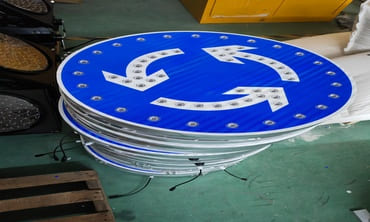
The solar panels of 2026 are no longer simple silicon slabs. Monocrystalline Silicon panels with PERC (Passivated Emitter and Rear Cell) technology are the standard. * Conversion Efficiency: Modern panels achieve 21-23% efficiency, allowing smaller panels to generate more power. * Low-Light Performance: These panels are optimized to harvest energy from the blue-light spectrum, which is prevalent during cloudy or rainy days, ensuring the battery continues to charge even when the sun isn't visible.
The controller is the "brain" that bridges the panel and the battery. * AI-Driven MPPT: RUICHEN’s proprietary controllers use AI to predict energy consumption. If the system detects a week-long storm approaching via its sensors, it will preemptively enter a "Power-Save Mode," adjusting the duty cycle of the LEDs to ensure the sign never goes dark. * BMS Integration: Advanced Battery Management Systems (BMS) monitor each cell's voltage and temperature, balancing the load and protecting against overcharge, over-discharge, and short circuits.
As we move toward Vision Zero and fully autonomous transit, solar traffic signs are becoming part of the Internet of Things (IoT).
In 2026, a road safety officer no longer needs to physically visit a sign to check if it's working. * Real-Time Dashboards: Through LTE-M or NB-IoT connectivity, RUICHEN signs report their status to a cloud-based dashboard. Engineers can monitor battery health, LED status, and even receive "Theft/Vandalism Alerts" if the sign is moved or tampered with. * OTA Updates: Firmware updates can be pushed "Over-the-Air," allowing authorities to change flashing patterns or timing schedules remotely across an entire city-wide network.
The most effective signs are those that respond to driver behavior. * Speed-Activated Warnings: Integrated Doppler radar allows signs to remain dormant or dim until a speeding vehicle is detected. This not only saves energy but also provides a "psychological jolt" to the driver, making the warning far more effective than a constant flash. * Traffic Data Collection: Beyond safety, these signs act as data nodes, collecting anonymous traffic volume and speed data that urban planners can use to optimize road design.
For hazardous curves or long work zones, Wireless Synchronization is a game-changer. Multiple RUICHEN signs can be linked via 2.4GHz or LoRa radio to flash in a perfectly timed sequence (e.g., a "running wave" pattern). This guides the driver's eyes through the geometry of the road, significantly reducing "run-off-road" accidents in low-visibility conditions.
Buying solar traffic signs in 2026 requires a shift in perspective. Municipalities and contractors must move from being "shoppers" to "engineers."
In the B2B infrastructure world, the cheapest sign is almost always the most expensive. A $300 sign that lasts 2 years has a cost of $150/year. A $600 RUICHEN sign that lasts 8 years has a cost of $75/year. When you add the $1,000+ cost of a maintenance deployment (truck, labor, safety permits), the high-quality sign is the only fiscally responsible choice. Performance per Year is the only metric that matters in 2026.
| Metric | Solar Radar Speed Series | Flashing Stop/Warning Series | Solar Chevron/Curve Series |
|---|---|---|---|
| Housing Material | ADC12 Cast Aluminum | Aluminum / UV-PC Blend | Reinforced Aluminum |
| Battery Type | LiFePO4 (12V/20Ah+) | LiFePO4 (6.4V/10Ah+) | LiFePO4 (3.2V/5Ah+) |
| Solar Panel | 18V/20W Monocrystalline | 17V/10W Monocrystalline | 5V/3W Monocrystalline |
| Visual Distance | > 1000 Meters | > 800 Meters | > 600 Meters |
| Autonomy (Rainy Days) | > 7 Days (Adaptive) | > 10 Days (Adaptive) | > 15 Days (Sync-Flash) |
| IP / IK Rating | IP66 / IK10 | IP65 / IK08 | IP68 / IK10 |
| Operating Temp | -40°C to +80°C | -30°C to +75°C | -40°C to +85°C |
| Connectivity | IoT / LTE-M Optional | Optional | Wireless Sync (LoRa) |
| Radar Range | 200m - 300m | N/A | N/A |
| Compliance | MUTCD / CE / RoHS | MUTCD / EN12352 | EN12352 / ASTM |
With over 15 years of dedicated R&D, RUICHEN Traffic has evolved from a manufacturer into a global safety partner. Our expertise in custom engineering allows us to solve the world's most difficult infrastructure challenges. * Philippine Typhoon Resilience: Our signs are the standard for resilience in the typhoon-prone islands of the Pacific. * Middle East Thermal Management: Our specialized cooling designs ensure 100% uptime in the 50°C+ heat of the GCC region. * European Smart Cities: We are the preferred partner for IoT-integrated urban safety projects across the EU.
Check the full technical specifications for RUICHEN’s solar traffic sign series.
The road safety decisions made in 2026 will echo for a decade. By choosing solar traffic signs that prioritize material science, energy intelligence, and structural durability, road authorities can build a resilient network that saves lives and taxpayer money simultaneously.
Investing in high-quality infrastructure is not just a regulatory requirement; it is a moral and economic imperative. As we move toward a future of autonomous and connected transit, the "active" visibility provided by RUICHEN Traffic will be the foundation upon which safe cities are built.
For technical consultations, bulk B2B quotes, or distribution partnership inquiries, contact the RUICHEN engineering team today at info@rctraffic.com or visit www.rctraffic.com.
Q1: Do solar traffic signs work in regions with very little winter sunlight? A1: Yes. 2026 technology uses high-efficiency monocrystalline panels and AI-driven MPPT controllers that harvest energy from ambient "blue light" even on overcast days. Furthermore, the high-capacity LiFePO4 batteries provide up to 15 days of autonomy, ensuring the sign remains operational during extended dark periods.
Q2: How do you prevent theft and vandalism of the solar panels and batteries? A2: RUICHEN designs incorporate anti-theft mounting hardware and internal battery compartments that are inaccessible without specialized tools. Additionally, our IoT-enabled signs feature GPS tracking and "tamper alerts" that notify authorities the moment the sign is moved or opened.
Q3: What is the real lifespan of a LiFePO4 battery in a traffic sign? A3: Under standard operating conditions, a Grade-A LiFePO4 battery will maintain over 80% of its capacity after 2,500 cycles. In a traffic sign application, this typically equates to 7 to 10 years of service life, significantly outlasting the 2-year lifespan of traditional lead-acid batteries.
Q4: Can these signs be integrated with existing Intelligent Transportation Systems (ITS)? A4: Absolutely. Our signs can be equipped with LTE-M or NB-IoT modules that communicate via standard protocols (like MQTT or JSON). This allows them to feed data into existing city-wide traffic management software and receive commands for emergency overrides.
Q5: Are solar signs bright enough to be seen in heavy fog? A5: Yes. The high-intensity LEDs used in 2026-spec signs have a luminous intensity that cuts through fog far more effectively than the passive reflection of a static sign. Many RUICHEN signs also feature fog-sensing technology that automatically boosts brightness during low-visibility events.
Q6: How does the "Radar Integration" feature save energy? A6: Instead of flashing 24/7, the sign remains in a low-power "Standby Mode." The Doppler radar consumes very little power. When a vehicle is detected, the sign "wakes up" and flashes. This targeted approach saves up to 70% of energy compared to constant operation.
Q7: Is it difficult to replace the battery once it eventually reaches its end-of-life? A7: No. RUICHEN signs are designed with a modular architecture. The battery can be replaced in the field by a single technician in under 15 minutes, without needing to remove the entire sign from the pole.
Q8: What is the difference between IP65, IP66, and IP67 for traffic signs? A8: IP65 protects against water jets; IP66 protects against powerful water jets (heavy storms). IP67 means the unit can be fully submerged in water for 30 minutes. RUICHEN’s critical components are typically IP67-rated to ensure survival during flash floods.
Q9: How do you handle the high heat of desert environments? A9: We use ADC12 aluminum housings which act as a massive heat sink. Combined with high-temperature LiFePO4 chemistry and a BMS that features thermal cut-off, our signs operate safely in ambient temperatures up to 80°C.
Q10: Why is "Diamond Grade" sheeting necessary if the sign has LEDs? A10: The sheeting provides a "fail-safe." If the electrical system were ever to fail (e.g., due to extreme physical damage), the sign still functions as a high-quality static reflective sign, ensuring that road safety is never compromised.
Q11: Can the flashing patterns be customized for different road types? A11: Yes. Through our IoT interface or local Bluetooth connection, engineers can choose from various flashing frequencies and patterns (strobe, pulse, steady-burn) to match local regulations or specific safety needs.
Q12: Do solar traffic signs require a special type of mounting pole? A12: No. Our universal mounting brackets are designed to fit standard round, square, or U-channel posts. We provide all the necessary hardware for a secure, typhoon-resistant installation.
Q13: How do these signs contribute to a city's ESG (Environmental, Social, and Governance) goals? A13: Solar signs are 100% carbon-neutral in operation. They eliminate the need for fossil-fuel-powered grid electricity and the carbon footprint associated with frequent maintenance visits. They are a visible symbol of a city's commitment to sustainable, safe infrastructure.
Q14: What happens if a tree grows and shades the solar panel? A14: Our IoT monitoring system will detect a drop in charging efficiency and send an alert to the maintenance team, allowing them to trim the foliage before the battery level becomes critical.
Q15: Is there a limit to how many signs can be wirelessly synchronized? A15: Our LoRa-based synchronization can link up to 50 signs within a 1km radius, allowing for extremely long "safe corridors" or complex work zone sequences.
To truly solve the "downtime" dilemma, we must look at the specific engineering logic that governs a 2026 solar traffic sign. It is not just about having a large battery; it is about how that energy is utilized.
In professional signage, the LED flash is not a simple on/off state. It is a controlled pulse. RUICHEN's 2026 controllers use Pulse Width Modulation (PWM) to manage the intensity. During the day, the duty cycle might be set to 50% to ensure high visibility against the sun. At night, the AI reduces this to 10-15%, which is more than enough for visibility but drastically reduces the drain on the battery. This "Smart Pulsing" is what allows our signs to survive 15+ days of rain while maintaining a visual distance of over 800 meters.
Battery degradation is the silent killer of solar infrastructure. In the Middle East, ambient temperatures regularly hit 50°C. Inside a metal sign box, this can climb to 80°C. * The Aluminum Heat Sink: Unlike plastic, which traps heat, RUICHEN's ADC12 aluminum housing acts as a massive heat sink, drawing heat away from the internal electronics and battery. * BMS Thermal Protection: Our 2026 BMS (Battery Management System) features active thermal throttling. If the internal temperature exceeds 65°C, the system automatically slows the charging rate to prevent chemical stress on the LiFePO4 cells, effectively doubling the battery's operational life in desert conditions.
The performance of a solar sign is also dependent on its physical placement and orientation. In 2026, RUICHEN provides technical simulation data to help engineers optimize their deployment.
While many contractors install panels at a fixed 45-degree angle, 2026 best practices demand orientation based on latitude. * Equatorial Regions (e.g., Philippines, Malaysia): A flatter angle (10-15 degrees) is often better to capture the overhead sun and maximize energy during the rainy season. * High Latitude Regions: A steeper angle is required to capture the low winter sun and to allow snow to slide off the panel surface.
Even a 10% shadow on a solar panel (from a tree limb or a nearby building) can reduce power output by 50% due to the series-connection of cells. RUICHEN’s IoT-enabled signs feature "Shadow Alerts." If the system detects a consistent drop in charging during specific hours, it alerts the municipal team to check for new foliage or obstructions, preventing a "mystery failure" of the sign.
Vision Zero is the international goal to eliminate all traffic fatalities and serious injuries. Solar traffic signs are the front-line soldiers in this strategy.
Statistics from 2025 show that 75% of pedestrian fatalities occur at night. Solar-powered flashing crosswalk signs (RRFBs - Rectangular Rapid Flashing Beacons) have been shown to increase driver yield rates from 20% to over 85%. By providing active, flashing light that mimics emergency vehicle strobes, these signs command attention in a way that static signs cannot.
On highways, the speed of reaction is everything. A driver traveling at 120 km/h covers 33 meters per second. A static sign might be visible from 100 meters, giving the driver 3 seconds to react. A RUICHEN solar sign, visible from 1000 meters, gives that same driver 30 seconds. This extra time is the difference between a safe stop and a high-speed collision.
What makes a RUICHEN sign different? It is the rigor of our testing protocols. Every sign that leaves our facility has passed a "Gauntlet" of environmental stress tests.
While many competitors claim IP65 (water-resistant), RUICHEN tests for IP67. This means our signs are submerged in 1 meter of water for 30 minutes. In an era of increasing urban flash floods, this is the only way to ensure your safety investment isn't washed away by a single storm.
Roadside signs are targets for vandalism and accidental impact from road debris. Our IK10 rating means the sign housing can withstand a 20-joule impact (equivalent to a 5kg steel ball dropped from 40cm). This physical toughness ensures the internal electronics remain protected even in high-crime or heavy-industrial areas.
We subject our signs to 1,000 hours of intense UV radiation and salt-spray in specialized chambers. This simulates 10 years of exposure in a coastal desert environment. Only materials that show zero structural degradation or lens yellowing are approved for our 2026 product line.
As we look toward the 2030s, the decisions made by road authorities today will define the safety and efficiency of our transportation networks. The 2026 Solar Traffic Sign Buying Guide highlights a clear path: prioritize material science, embrace energy intelligence, and demand proven durability.
RUICHEN Traffic remains committed to being the technical anchor for this transition. We don't just manufacture signs; we provide the engineering certainty that road authorities need to protect their citizens. Whether you are managing a single hazardous curve or a nationwide highway network, the high-reliability standard of RUICHEN is your partner in building a safer, smarter future.
Q1: How do I calculate the specific energy needs for a sign in my region? A1: RUICHEN provides a "Solar Insolation Calculator" for our B2B partners. You provide the GPS coordinates, and we calculate the peak sun hours (PSH) for your location. We then size the solar panel and battery to ensure a minimum of 10 days of autonomy based on your local "worst-case" winter scenario.
Q2: What is the maintenance schedule for a RUICHEN solar sign? A2: For the first 5 years, maintenance is virtually zero. We recommend a simple visual inspection once a year to ensure the solar panel is clean and free of bird droppings or heavy dust. The IoT system will automatically alert you if the battery or LEDs require attention.
Q3: Can these signs be used in tunnels or under bridges? A3: Yes, using a "Remote Solar" configuration. The sign is placed in the dark area, and the solar panel is mounted up to 10-20 meters away in a sunny location, connected by a specialized high-efficiency DC cable.
Q4: How does the sign handle "Sign Fatigue" (drivers ignoring signs they see every day)? A4: Our AI-driven flashing patterns and radar activation are designed specifically to combat sign fatigue. By changing the flash frequency or only activating when a driver is speeding, the sign provides a "novel" stimulus that captures the driver's attention more effectively than a static or constantly flashing sign.
Q5: Is the LiFePO4 battery safe from "Thermal Runaway"? A5: Yes. Unlike Lithium-Cobalt (found in phones), LiFePO4 has an extremely stable chemical structure. It can withstand temperatures up to 270°C before beginning to decompose, and even then, it does not release oxygen, meaning it won't sustain a fire.
Q6: What happens if the solar panel is damaged by a rock or hail? A6: Our panels are protected by high-transmission tempered glass that is rated for 25mm hail at terminal velocity. If the glass is shattered, the panel may still function at reduced capacity, and our IoT system will immediately send a "Low Charging" alert for replacement.
Q7: Can I sync these signs with my existing traffic light controllers? A7: Yes. RUICHEN offers a "Signal Bridge" module that allows our solar signs to receive triggers from standard NEMA or 170/2070 traffic controllers, allowing the signs to flash in sync with specific signal phases.
Q8: How do the signs perform in extremely high altitudes (low oxygen, high UV)? A8: High altitude is actually an advantage for solar charging due to the thinner atmosphere (higher irradiance). However, the high UV is brutal on materials. This is where our ADC12 aluminum and UV-stabilized PC really shine, as they won't degrade like standard plastics.
Q9: What is the "Soft-Start" feature in your LEDs? A10: "Soft-Start" gradually ramps up the LED intensity over a few milliseconds rather than an instant "pop." This is much easier on the driver's eyes at night and reduces the inrush current on the battery, extending the life of the electronic components.
Q10: Are there any tax incentives for installing solar traffic signs? A10: Many countries offer "Green Infrastructure" grants or tax credits for switching to solar. In the US, the "Carbon Reduction Program" under the Bipartisan Infrastructure Law often covers 80-100% of the cost for solar safety upgrades. Check with your local federal or state transportation office for current programs.
.jpg)
.jpg)
.jpg)
.jpg)