Solar vs. Hardwired Radar Speed Signs: A Strategic Guide for Distributors and Project Managers
Executive Summary: The Infrastructure Dilemma
In the modern landscape of urban planning and highway management, the need for effective speed enforcement has never been more urgent. From high-speed desert corridors to quiet residential school zones, the goal remains the same: reducing fatalities and ensuring driver compliance. However, project managers and traffic engineers often face a critical infrastructure dilemma: Should they invest in traditional hardwired (AC-powered) systems or opt for modern solar-powered alternatives?
For decades, hardwired systems were the "gold standard" due to perceived stability. But as we move into 2026, the tides have shifted. The immense costs of trenching, the bureaucratic hurdles of grid permitting, and the vulnerability of centralized power have led infrastructure project leads to increasingly move away from grid-tied systems. This guide provides a comprehensive technical and strategic comparison, demonstrating why modern solar technology—specifically the systems engineered by RUICHEN Traffic—is now the industry benchmark for reliability and cost-effectiveness.
The Hardwired (AC) Reality: High Costs and Hidden Delays
While hardwired radar speed signs offer a continuous stream of grid power, the path to making them operational is fraught with logistical and financial challenges that can derail project timelines.
1. Trenching & Cabling: The Immense Labor and Material Costs
The most significant "pain point" of any hardwired installation is the earthwork. - Labor Intensity: Trenching requires heavy machinery, road closures, and a large labor force. In many urban environments, the cost of digging a trench can range from $20 to $50 per linear foot, depending on the surface (asphalt, concrete, or soil). - Material Costs: Beyond the labor, the project must account for conduits, high-voltage cabling, and junction boxes. For a remote highway project where the nearest power source is half a mile away, these costs can easily exceed the price of the radar sign itself by fivefold.
2. Permitting Hurdles: Dealing with Utility Companies
Connecting to the grid is rarely a "plug-and-play" process. - Grid Dependency: Project managers must coordinate with local utility companies, which often leads to months of delays in inspections, meter installations, and grid connection approvals. - Bureaucracy: In many jurisdictions, obtaining a power permit for a single roadside device involves multiple government agencies, adding significant administrative overhead to the project.
3. Vulnerability: The Risk of Centralized Failure
A hardwired system is only as reliable as the grid it’s connected to. - Grid Outages: Localized power failures, grid maintenance, or accidental wire damage during unrelated construction can disable critical safety equipment exactly when it's needed most. - Maintenance Complexity: When a hardwired sign fails, the issue could be in the sign, the transformer, or hundreds of feet of buried cable, making troubleshooting a complex and expensive endeavor.
.jpg)
The Solar Revolution: Addressing the "Stability" Myth
Historically, some engineers viewed solar power with skepticism, labeling it as "weather-dependent" or "unreliable" during long periods of overcast skies. In 2026, these beliefs are officially outdated myths.
1. Eliminating the "Weather-Dependent" Myth
Modern solar systems are no longer "day-to-day" operations. They are designed as energy-autonomous nodes. - The 2026 Standard: Advanced battery chemistry, specifically Lithium Iron Phosphate (LiFePO4), has revolutionized energy storage. Unlike older lead-acid batteries, LiFePO4 cells can handle thousands of deep-discharge cycles without capacity loss, providing a massive "energy buffer." - High-Efficiency MPPT: Modern Maximum Power Point Tracking (MPPT) controllers can harvest energy even from ambient light on heavily overcast days, ensuring the system remains charged even in less-than-ideal conditions.
2. Total Cost of Ownership (TCO): The Financial Verdict
When comparing the lifecycle costs of Solar vs. Hardwired, the winner is clear: - Zero Installation Labor for Power: Solar signs are "drop-in" solutions. They mount to existing poles and are operational in minutes. - Zero Monthly Bills: A solar sign pays for itself by eliminating the monthly utility bills and the "meter charge" associated with grid connections. - TCO Advantage: Over a 10-year lifecycle, a solar-powered radar sign typically costs 60-70% less than its hardwired counterpart when all installation and operational costs are factored in.
Technical Deep Dive: Why RUICHEN Traffic’s Solar Radar Signs are Project-Ready
The stability of a solar system depends entirely on the quality of its engineering. RUICHEN Traffic has set the standard for project-ready solar radar signs by focusing on three core pillars:
1. Unmatched System Stability
Our signs are not just "solar-powered"; they are "energy-intelligent." - 5+ Days of Autonomy: RUICHEN’s intelligent energy management system ensures 24/7 operation even after five consecutive days of heavy rain or total cloud cover. The system automatically adjusts LED brightness based on battery levels to prioritize uptime without sacrificing visibility.
2. Durability in Harsh Environments
From the humid monsoons of Southeast Asia to the 50°C heat of the Middle East, RUICHEN signs are built to survive. - IP66 Ratings: Our radar enclosures are vacuum-sealed to prevent dust and moisture ingress. - Thermal Management: The ADC12 aluminum housing acts as a massive heat sink, protecting the sensitive radar and battery modules from thermal degradation.
3. High-Precision Radar Technology
We do not compromise on performance. RUICHEN signs utilize high-precision Doppler radar that matches or exceeds the accuracy of hardwired systems. - Accuracy: +/- 1 km/h. - Range: 200m+ detection distance, giving drivers ample time to react.
Comparative Analysis Table for Distributors
| Feature | Hardwired (AC) Radar Signs | RUICHEN Solar Radar Signs |
|---|---|---|
| Installation Time | Days to Weeks (Trenching required) | < 30 Minutes (Plug & Play) |
| Labor Cost | High (Heavy machinery & electricians) | Minimal (Basic mounting) |
| Power Reliability | Dependent on Grid Stability | Autonomous (Energy-Intelligent) |
| Monthly Energy Bill | Recurring Monthly Cost | $0.00 |
| Scalability | Limited by Power Grid Access | Infinite (Install anywhere) |
| Maintenance | Complex (Underground wire checks) | Minimal (Self-diagnostic IoT) |
The Verdict: Why Solar is the Smart Choice for 2026 Projects
The data is conclusive: for 2026 and beyond, solar is the superior strategic choice. It offers faster deployment, lower capital expenditure (CAPEX), and zero operational expenditure (OPEX) for power. Distributors can confidently recommend RUICHEN’s solar series to government and private clients, knowing that the "stability" concerns of the past have been solved by superior engineering.
Product Spotlight: RUICHEN Radar Speed Sign Series
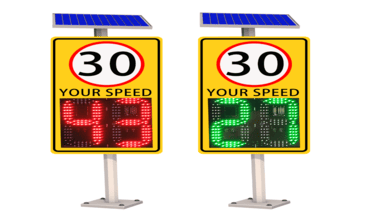
The RUICHEN Radar Speed Sign Series is the culmination of years of R&D in traffic safety. - Key Features: Ultra-bright LED display, customizable speed thresholds, data logging capabilities (traffic volume/average speed), and optional IoT remote management. - Build Quality: Marine-grade aluminum and UV-stabilized polycarbonate.
Check out the full technical specifications of the RUICHEN Radar Speed Sign Series here.
Conclusion & Call-to-Action
Infrastructure is evolving, and the reliance on the power grid for roadside safety is becoming a thing of the past. By choosing solar, you are choosing a more resilient, cost-effective, and environmentally friendly future for road safety.
Explore the RUICHEN Radar Speed Sign Series here: https://www.rctraffic.com
Contact our engineering team today for regional distribution partnerships, bulk project quotes, and customized traffic safety solutions.
Extended FAQ Section
Q1: Does the solar sign work at night? A1: Yes. The energy harvested during the day is stored in the high-capacity LiFePO4 battery, providing more than enough power for 24/7 operation, even during long winter nights.
Q2: How long does the battery last before replacement? A2: RUICHEN’s LiFePO4 batteries are rated for 2,000+ charge cycles, which typically equates to a service life of 5 to 8 years depending on the environment.
Q3: Is it difficult to install on existing poles? A3: Not at all. Our signs come with universal mounting brackets designed to fit standard U-channel, square, or round poles. No special electrical training is required.
Q4: How does it handle extreme winter or tropical monsoon conditions? A4: The IP66-rated housing protects against heavy rain and snow. In winter, the high-efficiency panels are angled to maximize winter sun, and the battery chemistry is optimized to maintain performance in cold temperatures.
Q5: Can I collect traffic data from these signs? A5: Yes. Our series includes internal data logging that tracks vehicle counts and speeds, which can be downloaded via Bluetooth or viewed remotely via our IoT cloud platform.
Q6: What happens if the panel is covered in snow or dust? A6: Our systems are "over-sized" in their energy harvesting capacity. While a total blockage will reduce charging, the 5+ days of autonomy ensures the sign remains operational until the next rain or maintenance cycle clears the panel.
Strategic Engineering: Why Project Managers are Switching to Solar
To understand the strategic shift, we must look at the granular details of project execution. In the infrastructure world, "Time is Money," and hardwired systems are notoriously time-consuming.
1. Reducing Project Lead Times
A typical hardwired radar sign project involves: - Site survey for power access. - Utility company application and approval. - Hiring a specialized electrical contractor. - Trenching and road restoration. - Final electrical inspection.
This process can take 6 to 12 weeks. In contrast, a solar project involves: - Site survey for sun exposure. - Installation.
The solar project is completed in under 48 hours. For a distributor, this means faster inventory turnover and happier clients who see immediate results.
2. The Resilience Factor: Decentralized Safety
In 2026, resilience is a key metric for "Smart Cities." Hardwired systems create a single point of failure. If a main transformer goes down, an entire district's speed enforcement goes dark. Solar signs create a Decentralized Safety Network. Each sign is its own power plant. A failure in one location—whether due to an accident or a technical glitch—has zero impact on the rest of the network. This "Distributed Reliability" is why high-stakes projects, such as those in Saudi Arabia's NEOM or the UAE's highway networks, are prioritizing autonomous solar nodes.
3. Environmental and ESG Compliance
Most government tenders now include ESG (Environmental, Social, and Governance) requirements. - Carbon Footprint: Hardwired signs rely on the local grid, which may be powered by fossil fuels. Solar signs are 100% carbon-neutral in their operation. - Light Pollution: RUICHEN’s intelligent dimming technology ensures that signs are visible but do not contribute to excessive light pollution in sensitive ecological or residential areas.
Deep Technical Dive: The RUICHEN Energy-Intelligent Logic
What happens during a "worst-case scenario"—ten days of rain in a tropical monsoon? - Stage 1: Adaptive Dimming. When the battery drops below 40%, the system slightly reduces LED intensity during late-night hours when traffic volume is lowest. - Stage 2: Frequency Optimization. The radar's polling frequency is adjusted to conserve micro-watts of power while still providing accurate feedback to passing vehicles. - Stage 3: Thermal Protection. In extreme heat, the BMS (Battery Management System) throttles the charging rate to prevent heat buildup, extending the chemical life of the cells.
This level of "Energy Intelligence" is what separates a professional RUICHEN system from a "budget" solar sign. It is the difference between a device that works all year and one that fails when you need it most.
The Verdict for Distributors: Confident Recommendations
As a distributor, your reputation is tied to the reliability of the products you sell. Recommending a hardwired system in 2026 is often recommending a solution that is more expensive, slower to install, and more prone to maintenance headaches. RUICHEN Traffic’s solar radar speed sign series provides the stability of hardwired with the flexibility of solar. It is the "no-compromise" solution that meets the aggressive demands of modern infrastructure projects.
Explore the RUICHEN Radar Speed Sign Series here: https://www.rctraffic.com
Contact our engineering team today for regional distribution partnerships, bulk project quotes, and customized traffic safety solutions.
.jpg)