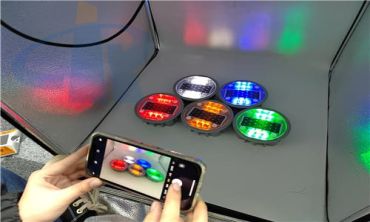
As Qatar pushes forward with renewable energy and smart infrastructure projects, solar street lighting is playing an increasingly vital role in its urban and rural development. However, Qatar’s desert climate poses unique challenges—extreme heat, intense sunlight, frequent dust and sandstorms, and coastal salt exposure can cause standard solar lights to degrade quickly. In this article, we provide a detailed, jargon-friendly guide to choosing high-spec solar street lights tailored for Qatar’s conditions, with a focus on pre-sales evaluation and technical selection criteria.
Qatar’s National Vision aims for 4 GW of solar capacity by 2030 to provide about 20% of its electricity from renewable sources0]. Major events like the FIFA World Cup have driven early adoption of solar infrastructure: for example, 350 off-grid solar street lights were installed in Doha to bolster the green agenda. These initiatives highlight the nation’s commitment to sustainable lighting, but also its need for solutions engineered for Qatar’s unique climate.
Qatar has a hot desert climate with average summer temperatures often exceeding 40 °C and occasional peaks above 50 °C. Winter nights can still drop to 15–25 °C. The combination of relentless sun and little rainfall results in very high solar irradiation (around 6–7 kWh/m²/day) but also generates extreme heat on solar panels and luminaire housings. In practice, a solar panel under Gulf sun can reach surface temperatures exceeding 65–70 °C, far above the standard test condition of 25 °C. At typical silicon temperature coefficients (~-0.5%/°C), operating at 65 °C would reduce panel output by roughly 16%. This means “standard” panels lose significant performance under Qatar’s heat.
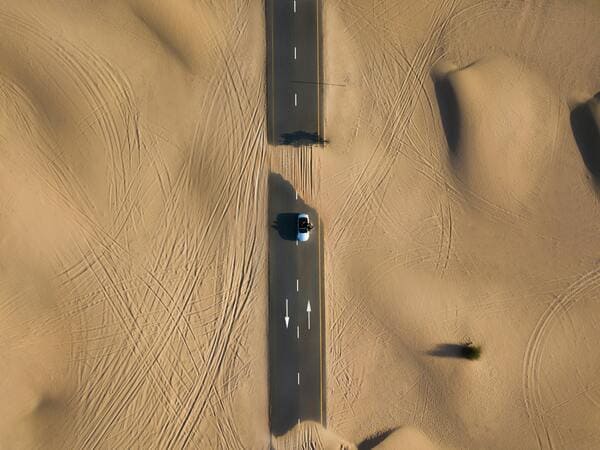
In addition to heat, Qatar experiences frequent dust and sandstorms, especially in spring and summer. Fine sand and dust settle on any horizontal surface, including solar panels. Published research shows that soiling can reduce PV output by up to 40–60% in desert environments. The effect is twofold: panels receive less sunlight, and intense sandstorms (often called “haboobs”) can blanket panels in minutes. Without effective cleaning or dust-repellent design, lights suffer from dim output and frequent outages.
Operating temperatures frequently exceed 45–50 °C. At such temperatures, electronic components and batteries are stressed. Many off-the-shelf solar lights are only specified to +40 °C or +45 °C. For reliability in Qatar, each component must be rated for at least +55 °C–+60 °C. In practice, this means choosing high-temp versions: LED drivers and wiring with wide temperature specifications, and battery chemistries proven at high heat. For example, lead-acid batteries lose efficiency sharply above 40 °C, whereas LiFePO4 batteries remain stable even at 50 °C. Procurement managers should ask for tests: is the luminaire specified for 60 °C ambient? Does it have heat dissipation (e.g. fins or vents) designed into the housing?
Lights must be both sandstorm-tested and easy to keep clean. Tilted panel mounts (so sand falls off) or automated cleaning brushes can help. High ingress protection (IP) ratings – typically IP65 or IP66 – are required so that fine sand cannot enter the enclosure. Many Middle East suppliers provide IP66-rated fixtures for this reason. Qatari tenders often demand IP65 minimum for outdoor lighting, but for desert use IP66 (dust-tight and protected against water jets) is preferred. Ensure gasket seals and cable glands are of Gulf-grade quality. In addition, UV-stable materials (UV-resistant polymers or powder coatings) extend life under intense sun.
Coastal Qatar can reach 80% humidity, and salt spray from the Gulf can corrode equipment. Solar street lights should use robust materials: die-cast aluminum housings with corrosion-resistant finishes (e.g. anodized or marine-grade powder coat). Stainless steel or galvanized fasteners prevent rust. IP67-rated junction boxes can be beneficial in beachfront areas. Even though rainfall is minimal, consider that morning dew with dust can “cement” dirt on panels. Some suppliers offer hydrophobic anti-dust coatings on glass. In summary, the materials and seals must be specified for desert/saline environments to avoid early failure.
.png)
Before procurement, confirm that solar street lights meet Gulf and international standards. For instance, SASO has mandated product registration on the SABER platform for lighting, requiring a Product Certificate of Conformity (PCoC) and a Shipment Certificate of Conformity (SCoC) to enter Saudi Arabia. SASO 2902 explicitly covers solar street lights111}. In Qatar, Kahramaa (Qatar General Electricity & Water Corporation) oversees electrical compliance, especially for grid-connected equipment112}. While off-grid solar lights technically fall outside Kahramaa’s scope, tenders often still require Kahramaa sign-off or IEC certification. It’s wise to ensure the products either have a SASO/SABER pathway or an IECEE CB/SIRC certificate that can translate into Gulf approvals.
Additionally, many Gulf countries now demand minimum quality metrics. A recent industry guide recommends key parameters: LED efficacy ≥120 lm/W, Grade-A solar panels (≥18% efficiency, 25+ year warranty), lithium batteries with ≥2000 cycles, and IP65 protection at minimum113}. Government tenders often request lighting layouts (DIALux) and IES files in advance. In practice, preparing third-party test reports (TÜV/SGS/BV) and 3D lighting simulations can win procurement confidence.
Procurement managers should approach a solar street lighting project like critical infrastructure. Key pre-sales steps include:
 hereas cheap lights use sealed lead-acid with 1-2 year life. Also plan for maintenance: ensure spare parts availability (LED modules, controllers) and ask if the supplier offers training for local technicians.
Select panels designed for heat and dust. Monocrystalline silicon (PERC or TOPCon) cells with efficiency ≥18–22% are standard for Gulf projects116}. Verify the panel’s temperature coefficient (lower is better; e.g. –0.35%/°C) and output at 65°C if available. The panel frame should be anodized aluminum (anti-corrosion), and the glass tempered with anti-reflective coating. Some suppliers now offer anti-soiling coatings on glass to repel dust. Top products may even use bifacial cells to leverage reflected light off sand. Example: RCTraffic’s premium module is >21% efficient (Grade A)117}, ensuring maximum harvest under Qatar’s sun.
High-quality LED chips and optics are the heart of the luminaire. Demand efficacy ≥120 lm/W (many suppliers offer 150+ lm/W now) and low lumen depreciation. Manufacturers should supply LM-80 (LED chip life) and LM-79 (complete luminaire photometry) reports. Choose a CCT suited to Qatar’s requirements (often neutral white 4000–5000K, CRI≥70). The LED driver should be a programmable, constant-current, dimmable type rated for –20 °C to +70 °C. Ensure the driver has protections (over-voltage, short-circuit) and ideally an astronomical clock or motion-sensing for energy saving. Some high-end lights include adaptive dimming or sensor-based profiles for even greater energy efficiency.
Modern solar street lights use lithium batteries, usually LiFePO4 (lithium iron phosphate), for long life and safety. Specify a battery system with ≥2000 discharge cycles (at ~80% depth of discharge) to ensure years of operation1. The battery should have an internal BMS (Battery Management System) to prevent over-charge/discharge and to balance cells. Check the operating temperature range: quality LiFePO4 packs can handle charging up to 50–55 °C119}, whereas most lead-acid cells cannot. For example, RCTraffic’s integrated light uses a high-end LiFePO4 unit with >2000 cycles20]20}. Also look for built-in lightning surge protection, as Gulf thunderstorms can induce voltage spikes.
The solar controller manages power flow and should be MPPT (Maximum Power Point Tracking) type for best efficiency. A good MPPT controller can extract up to 30% more energy than a simple PWM controller under variable temperatures and partial shading. Some advanced lights use dual-MPPT channels or multi-stage charging profiles221}. Ensure the controller’s current rating matches the panel’s output. It should be rated for high ambient temperatures too (50+ °C). Programmable controllers that allow setting dusk/dawn thresholds, dimming schedules, and overload protections are advantageous. Example: RCTraffic’s PRO-DOUBLE MPPT controller is specifically designed for continuous 24/7 lighting in harsh conditions222}.
The structural components must endure Qatar’s environment. Luminaire housings are usually die-cast aluminum (for good thermal conductivity and strength). RCTraffic lights use durable alloy bodies that are rustproof and impact-resistant223}. All edges should be sealed. Powder-coated surfaces should meet at least ASTM B117-96 salt-spray test standards. Poles (steel Q235 or aluminum) should be hot-dip galvanized (G-40 or better) and engineered for local wind loads. For split-mount designs (separate panel and light), ensure solid mounting brackets and cable management. Also consider ease of installation: some lights have quick-mount bases or adjustable tilt panels for alignment.
Modern solar streetlights can be more than simple lights. “Smart poles” integrate IoT devices: Wi-Fi hotspots, cameras, air-quality sensors, or EV charging points. If your project calls for it, specify the needed interfaces (e.g. RS485, CAN bus or wireless modules like LoRa). Some lights offer remote monitoring apps or GPRS connectivity to report power levels and faults. RCTraffic offers optional smart controls: buyers can add features like motion-triggered dimming (to extend autonomy) or remote power management. In general, clarify at the outset any smart-city integrations, since this affects controller electronics and often voids turnkey warranties if retrofitted later.
High-spec solar lighting suppliers will have product quality certificates and test reports. RCTraffic, for instance, follows ISO 9001 quality management and its products are certified CE, RoHS, FCC, IP68333}, meeting major international standards. Buyers should request third-party lab reports: thermal shock, humidity-freeze, UV aging, salt spray, and mechanical impact tests. Also verify IEC 60598-1 (luminaires), IEC 61701 salt mist, and any Middle Eastern standards (SASO, ESMA) if needed. Carefully read the warranty terms: a typical high-end solar light might guarantee 5 years on electronics and 5–10 years on PV output. Some Gulf projects even require performance bonds or insurance for multi-year operation.
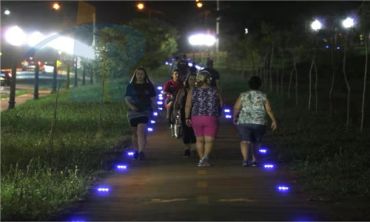
While Qatar-specific case data may be limited, lessons from the region apply. Prior to the 2022 World Cup, Doha installed 350 off-grid solar street lights around the city334}, demonstrating confidence in solar solutions. Elsewhere in the GCC, pilots of “smart” solar street lights have shown success. For example, one Gulf project used a “Stellar Series” light that was IP66-rated and sandstorm-tested to handle desert conditions335}. These examples illustrate that robustly engineered lights can operate reliably in the Middle East.
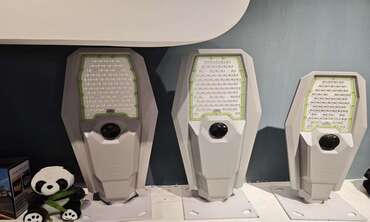
Henan Ruichen Traffic (RCTraffic) is an experienced OEM/ODM manufacturer with over a decade in solar lighting and traffic safety. As a supplier, they offer fully integrated solutions tailored to Middle East conditions. RCTraffic’s solar street lights (RC series) feature high-efficiency panels, high-grade LiFePO4 batteries, and robust aluminum housings336}. Their lights meet CE, RoHS, FCC and IP68 standards337} and can be tested for SASO/Kahramaa compliance upon request. Importantly, RCTraffic offers custom manufacturing: they explicitly work to client drawings or specifications338}, allowing design of poles, brackets or control systems to local needs.
For procurement, RCTraffic’s offerings come with global references and responsive support. The RC-UL model, for example, integrates a >21% panel, a >2000-cycle battery, an IP66 enclosure, and an automatic cleaning brush339}. By dealing directly with a manufacturer like RCTraffic, buyers get flexibility (OEM pricing, custom features) and shorter lead times compared to unbranded imports. We encourage interested readers to explore RCTraffic’s solar street light products for more technical details and quotes.
Choosing solar street lights for Qatar requires careful consideration of the harsh environment and regulatory demands. Standard off-the-shelf lights often fail under extreme heat and dust. By focusing on Middle East-spec solutions—such as lithium batteries rated for 60 °C, IP66 enclosures, UV-stable materials, and self-cleaning panels—procurement teams can ensure a reliable, long-lasting lighting infrastructure. Quality certifications (ISO, CE, SASO) and proven references should guide the decision. In summary, prioritize high-end components, proven durability and smart design to illuminate Qatar’s streets reliably while supporting the nation’s clean energy goals.
.jpg)